

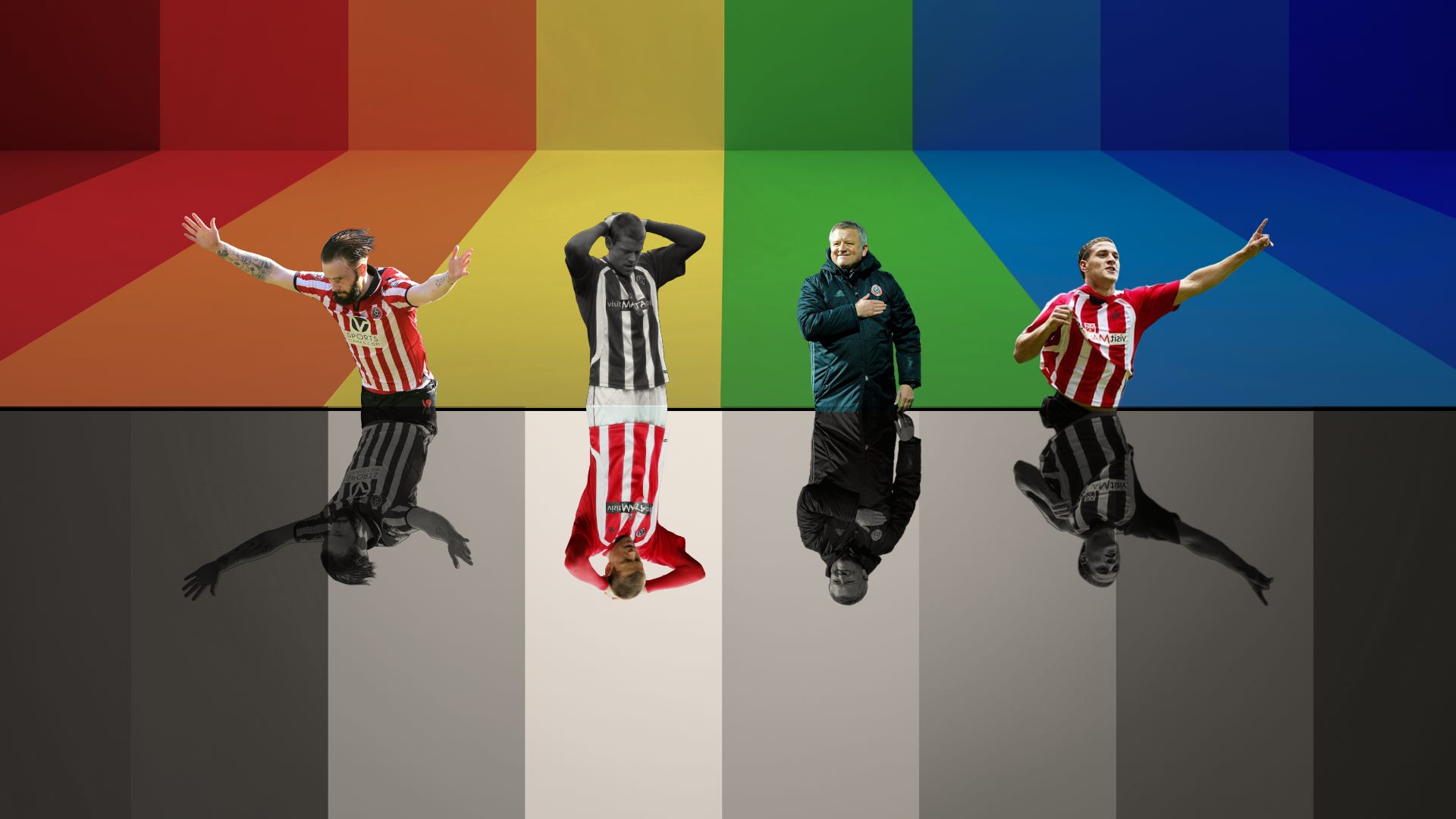
Words: Ben Meakin - Women of Steel
It’s been a season that will likely be remembered as the one where Sheffield United’s owners turned up outside Chris Wilder’s door, flowers in hand and tears streaming down their cheeks, begging please Chris, take us back.
There’s something about football that makes us constantly yearn for the past, to reach for the home comforts of the familiar. To airbrush the grubby bits from history and think fondly about what once was, and what could be again… if only we could get the band back together.
As the season peters out and we creep towards the summer transfer window, minds are naturally beginning to turn towards new signings. In many cases, though, it’s new old signings we’re interested in – is Harry Souttar fit yet? Would Hamza Choudhury take a wage cut? And is James McAtee going to be surplus to requirements at Forest?
There’s something undeniably attractive about the prospect of running it back when you’re looking to make things better. Why take the plunge on something that might not work when we have real evidence of something that does?
Except… does it actually work that way? Recent history is littered with examples of run-it-back loanees who didn’t work out, not to mention players returning for second spells on permanent transfers. There are exceptions, of course. But let’s take a stab at grouping some of these former-ex-Blades together, and seeing what we can learn from them before we start chasing our summer targets.
For the purposes of this article, I’m excluding players who’ve stitched lengthy loan spells together back-to-back – James McAtee, Dean Henderson, etc. Also excluded are players who were loaned and then immediately converted to permanent signings, like Oli Norwood and Danny Webber. They’ll be considered as players who had unbroken spells with United – I’m more interested in what happens when we try and, well, gerremback.
Unfinished business: success
Examples: Billy Sharp (the third time), Aaron Ramsdale, Phil Jagielka, Brian Deane (the second time)
I think all four of these had their Blades days cut short before their prime, and returned later in their careers with various levels of success.
Billy Sharp cemented his status as a club legend (but hold that thought), firing us to multiple promotions and becoming the top-scorer in EFL history. Aaron Ramsdale’s first spell ended with him barely having sniffed the first team; he returned some years later as a Premier League regular, won our player of the season and was promptly flipped for a profit to Arsenal.
Jagielka’s career was still on an upward trajectory when he left for Everton in 2007, as United tumbled out of the top flight (we’ll overlook the, ahem, hand that Jagielka played in that). He returned in his career’s twilight years, but was a solid enough freebie who would play another 50+ Championship games even after he left us a second time.
Brian Deane was re-signed in 1997 and picked up where he’d left off as one of United’s best modern goalscorers. Sadly he was so good that he quickly left again, but it’s hard to say this was anything less than a successful reunion (Deane did later return for a third spell at the tail-end of his career, but barely featured).
Who might fall into this category as a potential signing with unfinished business? A soon-to-be-36-year-old Kyle Walker fits here, although he’ll still be under contract at Burnley. It’s hard to see how we’d be willing to pay enough of his wages that the Clarets would be happy to send him here on loan next season, particularly as they’ll be in the same league – but then I never would’ve envisaged us signing Kalvin Phillips, so who knows.
Unfinished business: flop
Examples: Billy Sharp (the second time), James Beattie, Marcus Bent, Ched Evans
This is where it gets a little messy. The less said about Ched Evans’ reunion with the Blades, the better. But Billy Sharp returned to fanfare having racked up over 50 goals for Scunthorpe, and it subsequently took him eight months to get off the mark in his second Blades stint. Less than 18 months later, he was loaned to Doncaster and eventually sold.
James Beattie was so good that he still finished as our top scorer in 2008/09, despite being sold in January. A return less than three years later – in League One – seemed like it would be a winner.
Not so much. Beattie copped a straight red for putting a Charlton player in a chokehold mere minutes after coming off the bench, missed an open goal in a mood-altering loss at MK Dons in the days after the Ched Evans conviction, and signed off with another straight red at Exeter on the final day of the season, ruling him out of the playoffs and ensuring his second spell ended goalless. Yikes.
Finally, Marcus Bent had an electric start to his Blades career in 1999, scoring 13 goals in three months and convincing Blackburn to shell out £2m for him barely a year after United had bought him for less than a fifth of that fee. His return eleven years later was slightly bizarre at the time, and he made 10 goalless appearances before United – who were relegated – sent him back to Birmingham.
It seems a bit unfair to project a future returning signing to be a flop, but let’s get creative. Oli McBurnie has had a good season for Hull and feels ripe for a classic Sheffield United emotional overpay to bring him “home”, only for him to get injured in October and miss three months of the season.
Tommy Doyle hasn’t pulled up trees at Birmingham but would likely cost a pretty penny – is there a world where we make good money on Sydie Peck and promptly blow it on a slightly inferior replacement? Recent history has at least put it on my radar.
I don’t want to write this one, but seeing as it’s staring us in the face, there’s another Birmingham player that Chris Wilder loved enough to make captain, before that pesky Ruben Sellés shipped him out. Jack Robinson reunion, anyone?
The returning favourite AKA be careful what you wish for
Examples: John Brayford, Ben Brereton Diaz, Wayne Quinn, Jon Harley
The distinction between this and the above category is that these are players who were here for a relatively brief spell, saw their popularity among Blades fans soar, and had us pining for a return. When that return eventually happened… it wasn’t as good as we’d hoped.
Brayford was probably the most-loved player in red and white during a loan spell that saw us rise from the doldrums of the League One relegation zone to a playoff charge and an FA Cup semifinal. “The Beard” went on an all-out charm offensive upon signing, and us fans, wallowing in a few years of third-tier misery, lapped it up.
Re-signing him the following season seemed like a rare case of giving the people what they want – until it became apparent that we’d, incredibly, spent something like £2m to do so, while still scuffling around in League One.
Brayford was… okay in this second spell, but the magic had gone. The team struggled to evolve under Nigel Clough, and spending millions on an(other) right-back began to look like a colossal waste of resources. The denouement was no fault of Brayford’s: he picked up a bad injury filling in at centre-back in the playoffs, and barely played for us again. But it also laid bare some muddled thinking at board level, of investing many eggs in one right-back-shaped, admittedly handsome, bearded basket.
Ben Brereton Diaz should have been a home run returnee: an electric counterattacker in our pitiful Premier League season, he looked tailor-made to do the same for us in the league below. Sadly, not so much, as he was half the player who’d sparkled 12 months previously at a higher level – with a brief cameo in the playoff final serving as a brutal full stop.
Two players who had bigger gaps between spells were a pair of left-backs: Wayne Quinn and Jon Harley. Academy product Quinn was electric in his debut campaign in 1997/98, earning an England B call-up and getting snapped up by Newcastle. A few years later he was loaned back to the Blades, but made only six unmemorable appearances before dropping out of professional football altogether at the age of 28.
Harley’s loan spell from Fulham was well-received and we spent the next few years desperately hoping to get him back; he eventually joined on a free transfer but was a mediocre part of an unlovely Neil Warnock side that fell between the highs of 2002/03 and 2006/07.
Who is destined for an unfulfilling Blades reunion this summer? Hamza Choudhury’s stock among Blades fans was heightened by his ability to look like a competent if prosaic right-back during a loan spell where he was ostensibly brought in to play defensive midfield – I’m braced for a bland second stint in the wake of a Femi Seriki sale.
But to commit fully to the spirit of this section, let’s pick out a true Blades favourite where the only question is if he can still do it at his age. Oli Norwood has been stellar in League One and may be playing second-tier football with Stockport anyway next season, but there’s only one proper answer. Come back David McGoldrick – what can go wrong?
Do you remember the first time?
Examples: John Egan, Neill Collins
Weirdly, this category has a good hit rate, albeit a low sample size: players who you can barely remember their first spell, who returned a few years later to relative success.
John Egan played a single game for us in March 2012 as an emergency loanee; kudos to you if you were in attendance for that particular away loss to Walsall. Six years later he would become the club’s record signing, a key part in our promotion to (and survival in) the Premier League, and one of the most popular players of recent years.
Neill Collins’ Blades career never reached the highs of its first time, where he started in a 2-1 win at Hillsborough less than 48 hours after joining on loan in 2006. All the same, Collins did go on to make over 200 appearances for United, arguably shepherding Harry Maguire through the early stages of his career and playing at Wembley twice. Possibly a player who would be more fondly-regarded had we not botched that 2011/12 season.
Giving you a list of players you can barely remember is a bit of a contradiction (although it didn’t stop the excellent Memory Lane podcast giving it a go recently), but here’s a couple of names that might fit as returnees. Regan Slater and Ben Whiteman seem obvious ones, having barely scratched the first team for United as youth players but gone on to forge decent Championship careers at Hull and Preston.
Centre-back Ben Davies is out of contract at Rangers this summer, after spending two seasons on loan to Championship clubs. And would former long-time Wilder target Ryan Leonard be available if Millwall go up?
Bonus round: managers
Examples: Chris Wilder, Paul Heckingbottom
I’ll wrap this up by going full circle, much like Sheffield United’s owners. Arguably this is where the whole gerremback culture starts for this club: we just can’t quit ‘em.
Wilder’s three spells are well-documented enough that I won’t waste many words on them, but it’s easy to forget that Paul Heckingbottom was also an interim boss in the death throes of the 2020/21 lockdown season before getting the job permanently after Slavisa Jokanović’s sacking.
Heckingbottom’s succession by the man he replaced makes for a bizarre streak of Blades managers, where five of the last seven bosses have been either Chris Wilder or Paul Heckingbottom. That means that over the last 10 years, more than 94% of all Sheffield United games have had one of those two in the dugout. So much for familiarity breeding contempt.
Who’s next, though? United have been a pretty unserious club for a while now, so it’s not hard to envision Wilder getting canned (again) in the next 12 months and returning (again) shortly after.
But in a world where a 78-year-old Roy Hodgson can return to where it all started for him 42 years later, let’s fast-forward to the year 2041, and the grand unveiling of Sheffield United’s new old manager: Steve Bruce.
Absolutely loved this one. Thanks chaps!
Superb read, Ben.
I’d completely forgotten that Beattie returned at the end of that fateful season!
And at some point we will need to cut the apron strings of Wilder, but having suggested that be sooner rather than later makes me a social pariah (especially in my football group chat!)