

This article is the companion piece to the 25/26 season review published in May. It is probably helpful, if not essential, to read that one first.

Sam Parry
Hot off the news desk: Alan Knill has left Sheffield United. A fact known for more than a week, though just publicised by the club in what appears to have been a classic game of tight-lipped owner twattery.
Anyhow, it’s a decision that will be judged on outcome. If United win a few games early in 26/27, there’ll be a quiet acceptance that the call was fair: “told you we needed some new ideas”. At the same time, poor runs of form are an inevitability during any season. As soon as we hit one, the verdict will be swift: “Wilder can’t do it without Knilly” - you can bookmark that one because it’s happening.
For good or for bad, the collective football brain behind Sheffield United will not be the same as last season. It will be Chris Wilder, Micky Collins, Gary McSheffrey, Matt Prestridge, Matt Duke and now Phil Jones. So, basically the same plus Jones but minus Knill.
How many times Jones and Collins have overseen first-team training sessions is anyone’s guess. I’ll take a stab: very few. But new ideas it is. Chris Wilder said so himself: “We are now looking to inject some fresh ideas into the group.” Sounds a bit painful, or else something that someone else wrote for him.
I’m digressing.
This article is interested in the three main on-pitch traits that define “Recent Chris Wilder and Alan Knill” — call it CWAK Thinking. I have defined those as:
Possession dominance
High pressing
Strong chance creation
Taking each of these, one by one, I will outline how those traits looked last season, and apply a bit of ‘yin and yang’ thinking to the situation. Because within each of those traits were also the seeds of some of our biggest weaknesses.
Possession dominance… but no ‘Plan B’
High pressing… but too little control in the chaos
Strong chance creation… but weak finishing
Next season’s success will likely hinge on how we attempt to solve the strategic and tactical problems that defined the 2025/26 campaign. Some good new players would help too. But we’re talking tactics today. So let’s have a look.
Note: The data used in this piece comes from Opta Analyst, with all figures presented on a per-90 basis unless otherwise stated. Videos were annotated with the JLA Tactics Board.
1. Possession dominance… no ‘Plan B’
Under Wilder and Knill, Sheffield United have always been a possession-heavy side. Okay we dipped below 50% possession in the top flight, but otherwise we’ve always had more ball on average in every season they’ve been in charge.
The last campaign was no different. When in possession, United tended to use the ball to play forwards much more than backwards in what was a mixed/direct (not long ball) approach.
“Forwards, not backwards.”
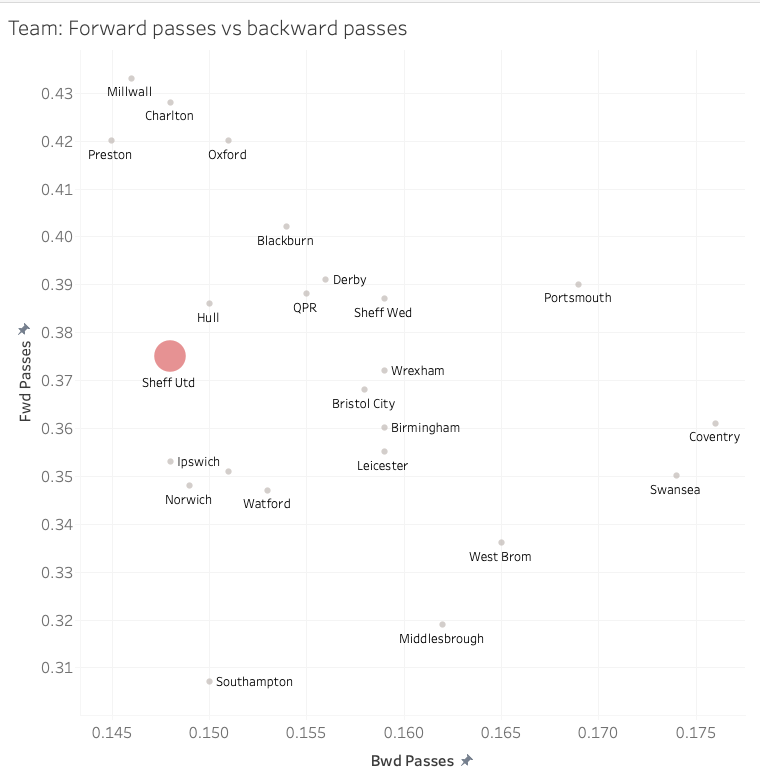
Compared to most opponents, that approach was possession dominant, but I wouldn’t say “possession heavy”.
Only eight Championship sides averaged more possession than United. Yet despite controlling the ball, United’s possession sequences lasted on average for just over 3 passes before they were ended by a defensive action, a stoppage or a shot. Among teams averaging more than 50% possession, only one side recorded fewer than our 3-ish passes per sequence.
“A lot of ball, a lot of giving the ball away.”
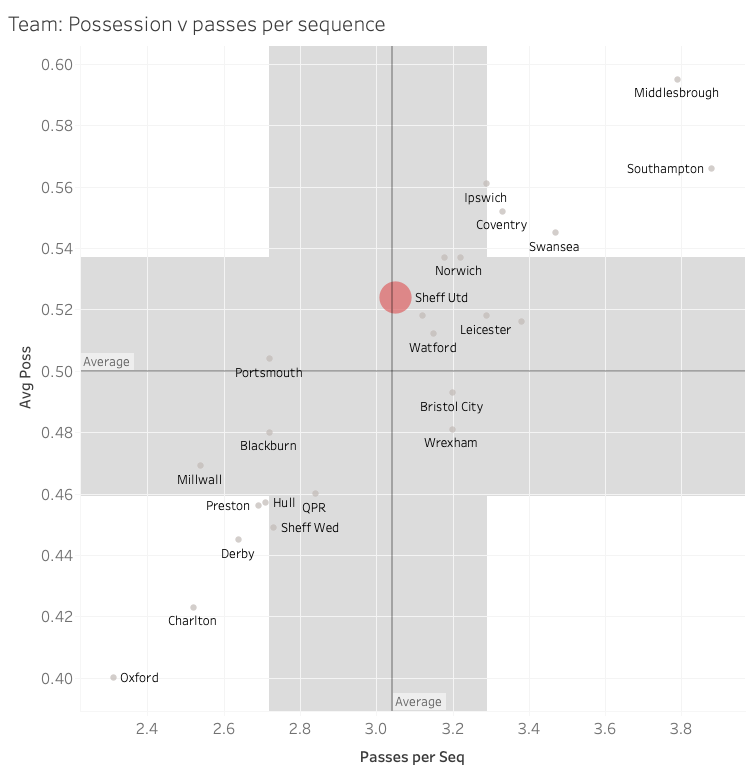
The basic formulation here is that in 25/26 we had a lot of the ball, but more often than not, for a short number of passes long. Why?
Part of that is down to the mixed/direct approach: we played forwards often, and if you pass the ball forwards, the opponent is more likely to get in the way.
Another reason might be that the attacking strategy was often straightforward: get the ball to our most dangerous players and let them do their thing. That is not necessarily a criticism. Gus Hamer, for example, was one of the most creative players in the division. Why wouldn’t you want to run games through a player who attempts difficult passes, takes risks and creates chances few others can see?
“Oooh Gus.”
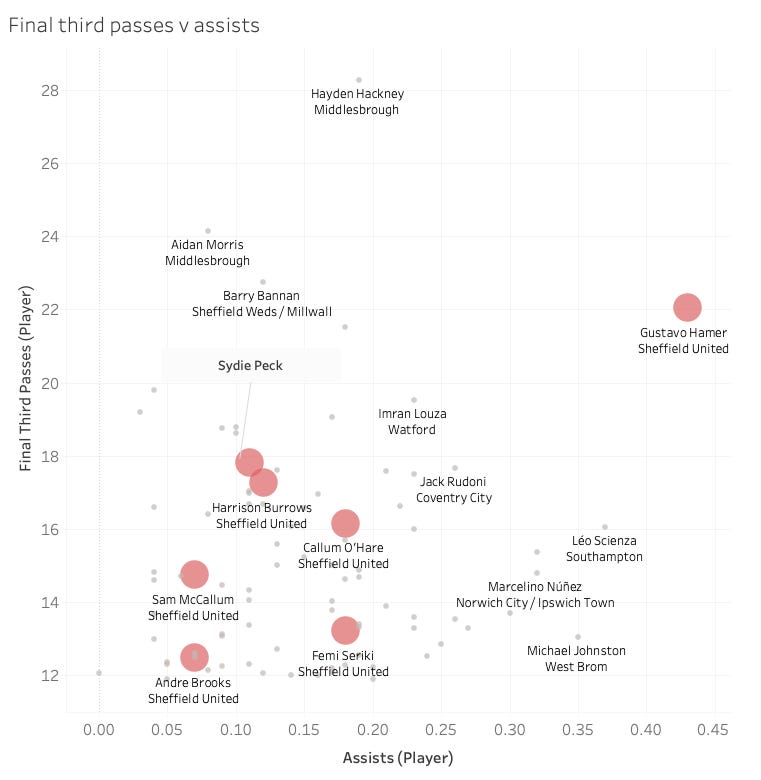
The trade-off is that risky football produces turnovers. Hamer’s long-ball completion rate sat below 50%, while his overall pass completion hovered around 76%. The mistakes are accepted because the rewards are enormous: goals! And the bigger issue was what happened when Hamer couldn’t find the answers or wasn’t available to try to solve the problem.
United lost 22 games (the second highest in the league). In those losses, we too often struggled to leverage possession into any kind of advantage. A huge part of that was down to the predictability of our build-up: on the left, find Hamer and hope he can slide a good through ball or find room for a shot; on the right, work it to Brooks to carry the ball closer to goal, either cutting in, making a short pass or finding Seriki on the overlap.
That mostly worked to good effect against the poorest teams in the division, where our best players were technically superior to their opponents. In those situations, our possession dominance allowed quality to tell. Against those clubs, we could camp in their half — and we did. United spent a lot of time in the opponent’s third, more than most, more than anyone in fact… except Boro.
“In the opponent’s half.”
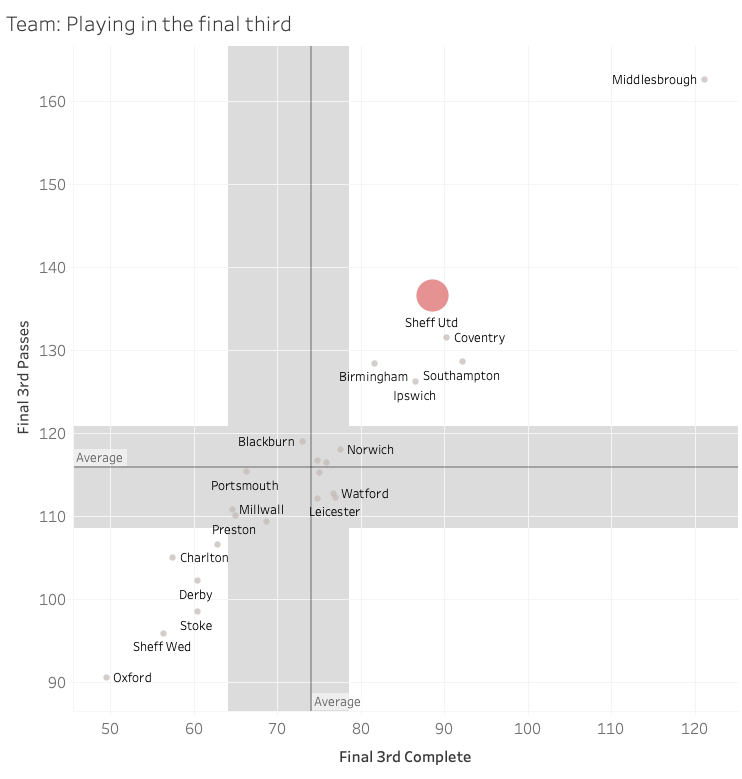
Any positive reflection on our build-up, though, is almost entirely centred around our ability to beat bottom-half teams, where our record was very good. Blimey, it was 2.00 PPG - an automatics-ish tally.
🟢 Vs Bottom-Half Teams (14th–24th)
Record: W14-D2-L6 (44 points from 22 games)
📊 52.8% possession
🔄 166 opposition-half passes per game
📦 27.4 touches in the opposition box per game
🎯 1.09 open-play xG per game
🛡️ Allowed 0.79 open-play xG per game
⚽ Scored 39, conceded 21
📈 Goal difference: +18
However, against the top 12 teams in the division, our record was dreadful. You would suspect that our failure to pick up points in these games had something to do with better teams preventing us from getting on the ball more often. Horror of horrors: that wasn’t remotely the case.
🔴 Vs Top-Half Teams (1st–12th)
Record: W4-D4-L16 (16 points from 24 games)
📊 52.2% possession
🔄 179 opposition-half passes per game
📦 28.6 touches in the opposition box per game
🎯 0.95 open-play xG per game
⚠️ Allowed 0.92 open-play xG per game
⚽ Scored 27, conceded 45
📉 Goal difference: -18
Let’s pause there: we pretty much had the same possession against top half (x12) and bottom half (x11) teams. We had more touches in the box against top half teams. And yet we won just 4 of 24 matches. Of course, we should expect a regression against better sides, but that’s absolutely bonkers.
Was that down to poor build-up?
I actually think our go-to build-up was pretty good, at times. The bigger issue was a lack of a go-to Plan B. What happens when you're struggling to break a side down? What happens when you’re chasing a game (in our case, probably after leading it in the first place). Our answer was lacking. Why?
Personnel for sure. A lack of bench impact, for certain. But also because every single side that played against Sheffield United went into the game knowing, with absolute certainty, that they wouldn’t be defending crosses. That’s a key bit of information available to every team, making their solution: force them wide, double and triple up on their combinations, and they’ll end up stuck.
“Blades don’t cross.”
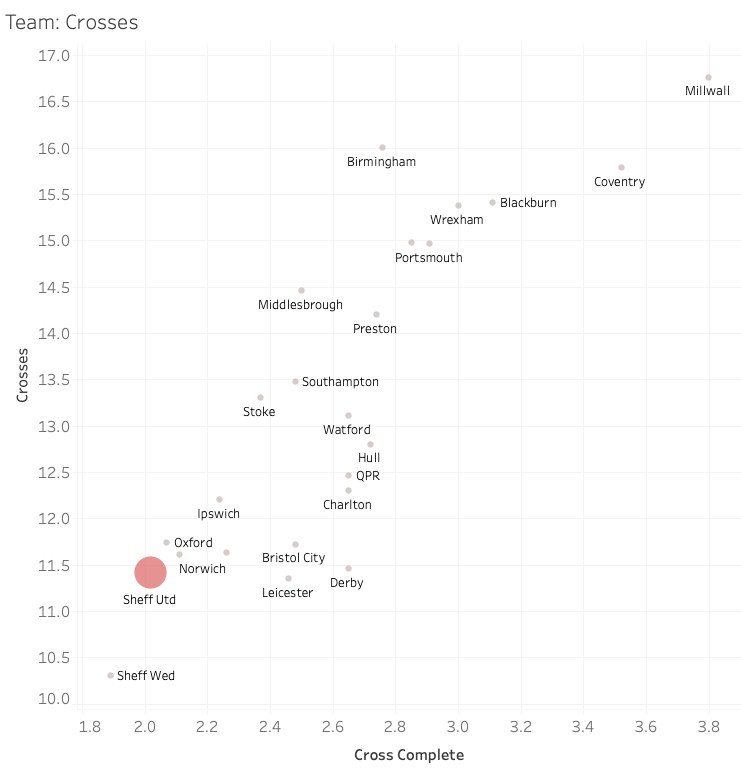
If you’re the best team in the league, say Ipswich, you tend not to need a Plan B: you just let the quality tell. Sheffield United in 25/26 was what happens when you play this way without having a big enough quality advantage.
We lacked an alternative route to goal. There was little aerial threat across the XI. Few deep crosses. No equivalent of the old Norwood delivery that could make a defence think twice about dropping in by causing chaos in the box.
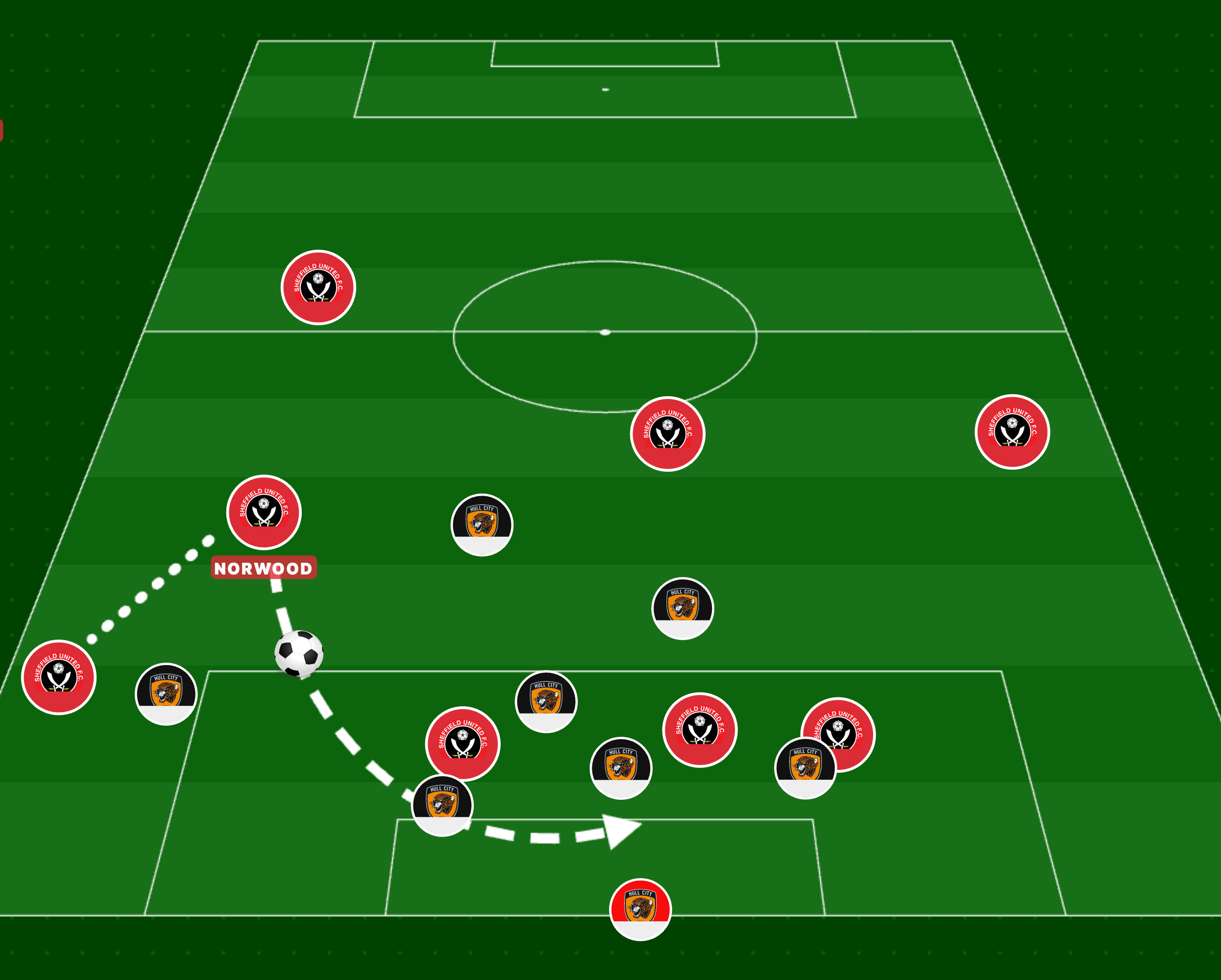
The issue wasn’t simply tactical. It was structural. Too much of the attack depended on a small group of exceptional players producing exceptional moments. But we’re not one of the top four sides in the division anymore — the reason for that has been spelt out on The Pinch and elsewhere a million times over. But when you aren’t the best, you need a Plan B.
The lesson for the post-Knill era is simple: add some variety. That could be through the recruitment of a new striker - ideally a big one. Or by getting Tyrese Campbell back into shape to play off the shoulder. But it’s also tactical, and I have two thoughts about our tactics.
For our forward players, we need to overload on one side sometimes. Just stick everyone wide. Make a set defence uncomfortable and confused. That’s how Boro do it. Cause a bit of chaos. Stretch a team.
For our central midfielders, whoever they are, I want to see the odd ball that’s different to the others. In cricket, it’s the possibility of a spin bowler turning the ball the other way that makes a batter antsy. In football, if you know a team won’t cross, you have one less thing to worry about. Is it impossible to throw a ‘wrong un’ into the mix every so often? Hey, it worked against Hull.
2. Strong pressing… but too little control in the chaos
If possession was, with caveats, one of United’s strengths, pressing was arguably our greatest one.
By PPDA (passes per defensive action), Sheffield United were the Championship’s most aggressive pressing side. We also began possessions higher up the pitch than almost anyone else.
“We’ll press where we want.”
PPDA is a stat that counts how many passes the defending team (in this case Sheffield United) allows the opposition to make before attempting a defensive action such as a tackle, interception, or a foul. The lower the PPDA, the more intense the press.
Start distance is the average distance in metres from a team’s (in this case Sheffield United’s) own goal line where their open-play possession sequences begin. The higher the start line, the higher up the pitch our possession begins.
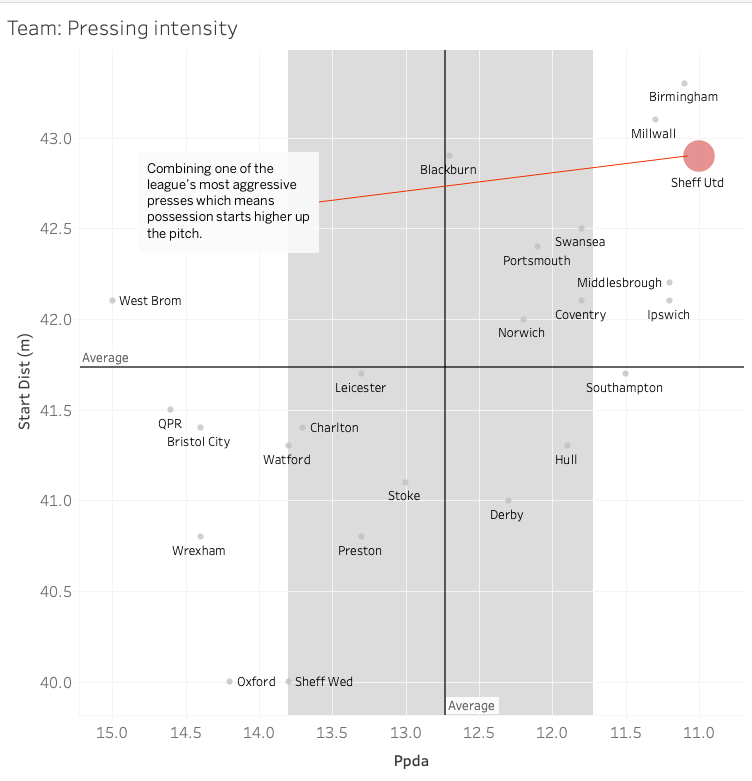
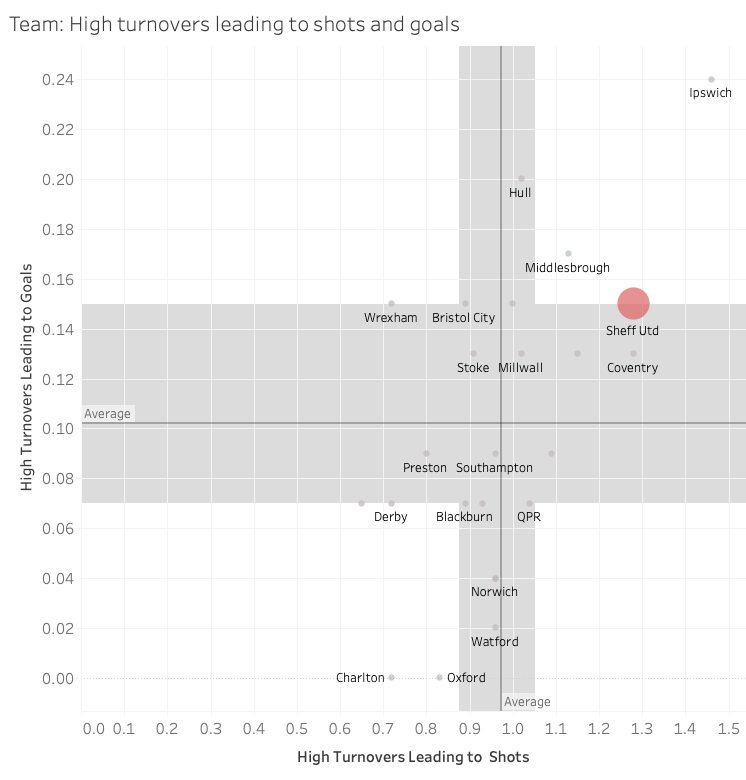
The press was not random. United consistently tried to isolate goalkeepers and centre-backs, deny passing lanes and force rushed decisions. The numbers suggest it worked. We ranked near the top of the league for high turnovers leading to both shots and goals.
“Turn it over.”
There was perhaps no clearer example of our pressing abilities than the opener against Leicester, which definitely benefited from some horrific defending. But we forced that issue. We were the instigators, and as someone who enjoys front-foot football, I love this.
The problem, in other games, was what happened when the first press failed. High pressing naturally creates space. Push your team higher, and the distances behind you become larger. That gets even more chaotic when you’re pressing a team who’ve just won the ball back off you, and I think our counter-press is dumb.
The best teams negotiate the chaos and manage the risk. United often didn’t. And just like our crossing, the Blades ranked lower than every Championship side other than Sheffield Wednesday for goals conceded on the break.
“161 or 11% of all league goals were fast breaks”
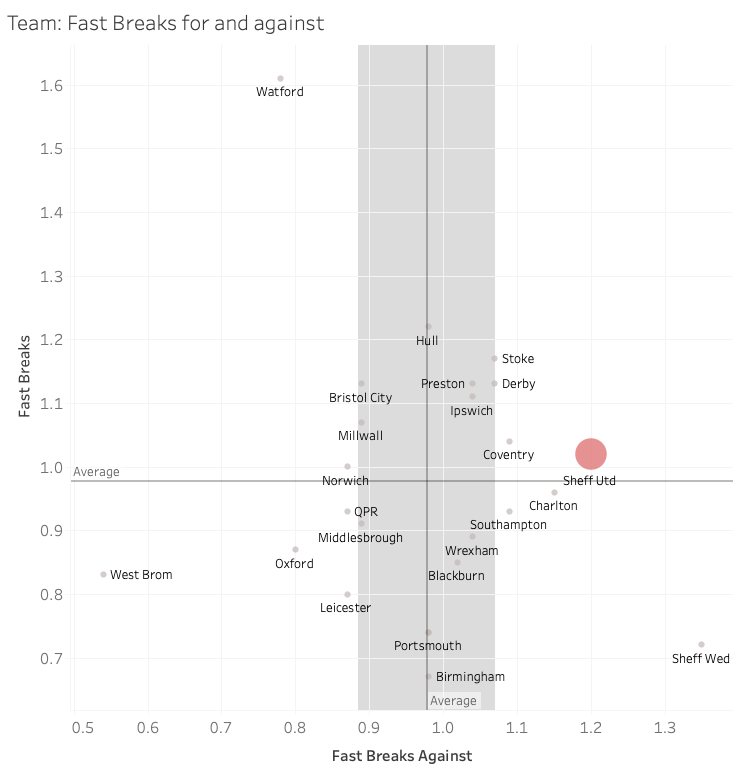
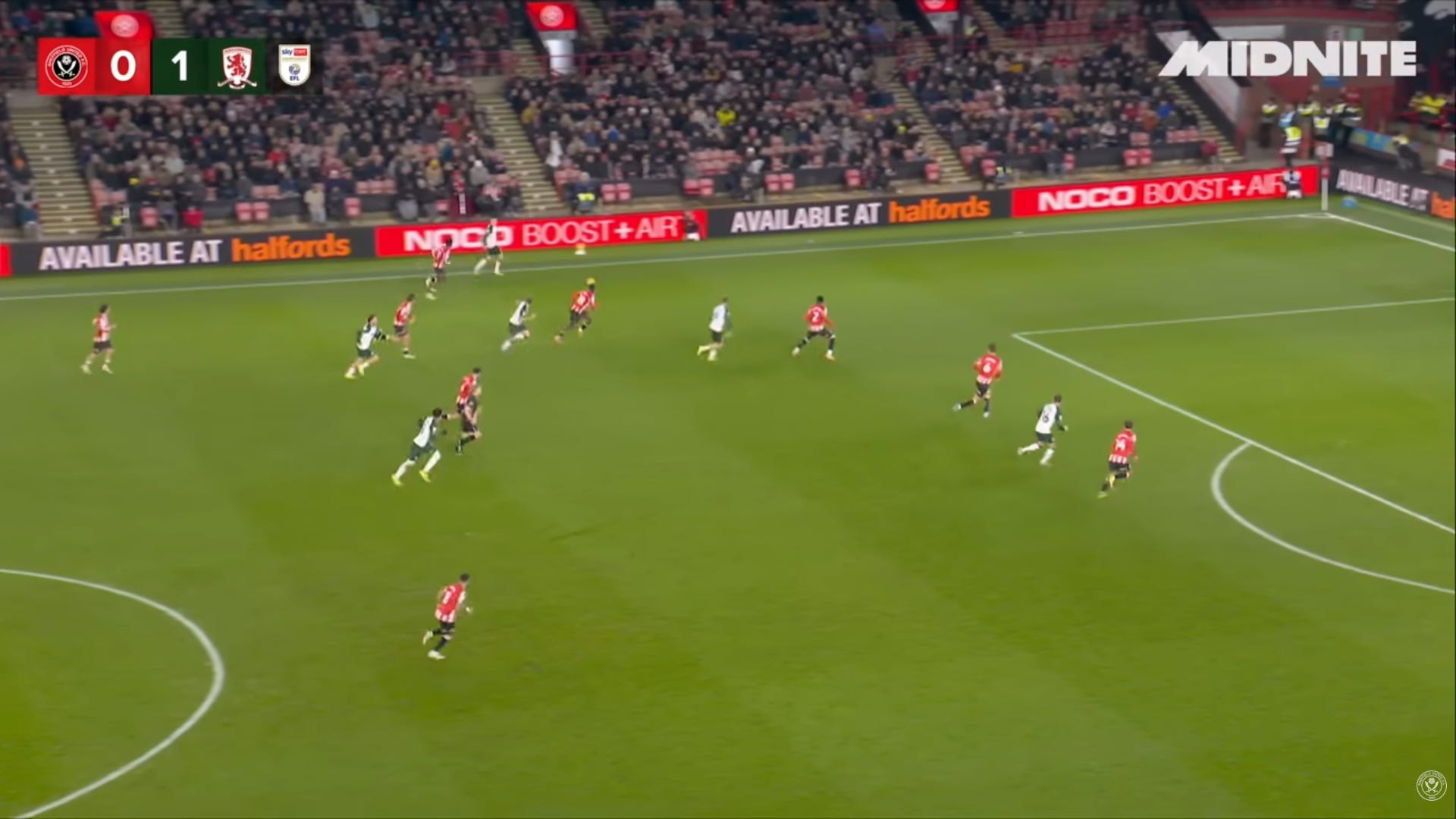
When 1 in 10 goals are scored on the break, it’s a shocking indictment of our team that we never fixed an avoidable issue. Too frequently, particularly after losing possession high up the pitch, the team became chaotic. Players hunting the ball and dragging the shape all over the place. Midfielders abandoning runners. Defensive responsibilities becoming blurred. We so often failed to reset into a clear shape that - ho ho - every team wanted us to get higher up the pitch to unlock our obvious vulnerability. See here against Boro:
The Middlesbrough example is not particularly instructive; Boro’s elite players find a counter-attack with exceptionally good technique. But once they find a space to open up the counter, our response is this awful bees-to-honey approach where nobody takes responsibility for stopping the long pass or picking up the one and only long ball target.
As I said earlier, it’s yin and yang stuff. If you’re going to press like we press, you also have to commit more tactical fouls, recover shape quicker and make better decisions in transition. The best pressing teams are not simply good at creating chaos; they are good at controlling it. And I just don’t think we were smart enough off the ball all season long — see also Blackburn.
The big lesson? We conceded more goals from fast breaks than we scored from fast breaks. We allowed our possession in the final third to become one of the opponent’s biggest strengths. Our defensive players, including covering central midfielders, weren’t good enough or mobile enough to reduce the threat of counter attacks.
What do we do about it?
Either we recruit a profile of player to continue this high press, or we are going to have to rethink how much we press. The central midfielders need to be much more switched on to nullify opponents beating the press. Riedewald was the only CM to do this, but even he just stood deep to mop up, rather than actually running around - and now he’s gone.
This pressing issue is nothing new, by the way. The final paragraph in an article from Total Football Analysis about our play-off final defeat to Sunderland read: “Sheffield United succeeded in forcing plenty of mistakes with their high pressure, but they didn’t take advantage of those Sunderland errors enough to win.”
That raises the third and final question. If we created lots of chances from our press, and if we created lots of chances in build-up, how many more points would we have secured if we turned those chances into goals?
Certainly more. It all boils down to finishing.
3. Good chance creation… but too few chances scored
The final contradiction is perhaps the most frustrating. Sheffield United created chances. Lots of them. And perhaps we created enough to mitigate the wrinkles in our possession and our pressing.
We also missed chances. Lots of them.
“We’ll miss where we want.”
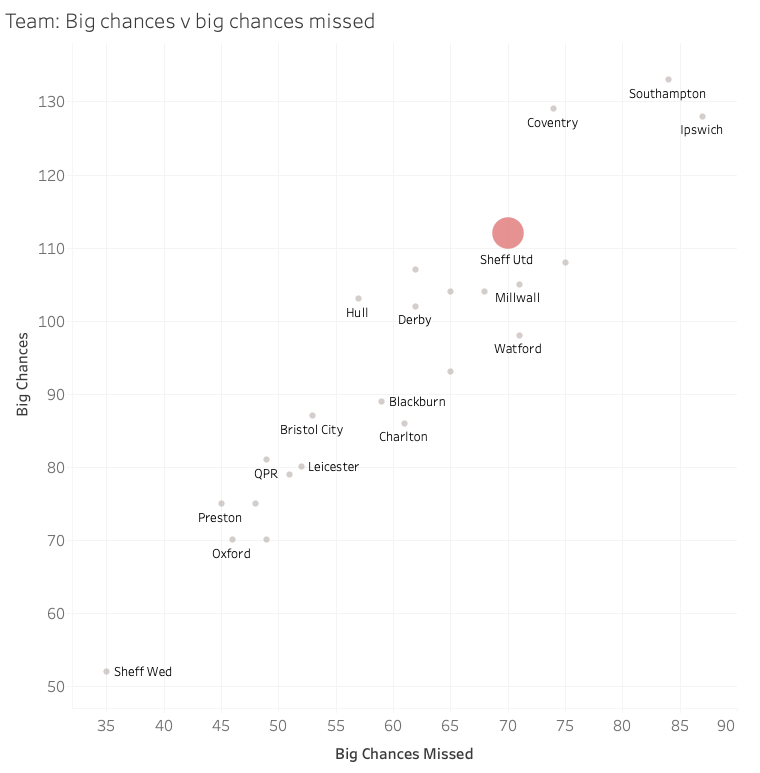
The relationship between big chances created and big chances missed is stronger than many fans would like to admit. It’s a good thing, normally. The best attacking sides usually appear high on both lists because creating chances is the difficult part — it’s better to have created and missed than not to have created at all.
Yet too often the final touch was missing. Ten of the sixteen outfield players to play more than 1,000 minutes underperformed their expected goals.
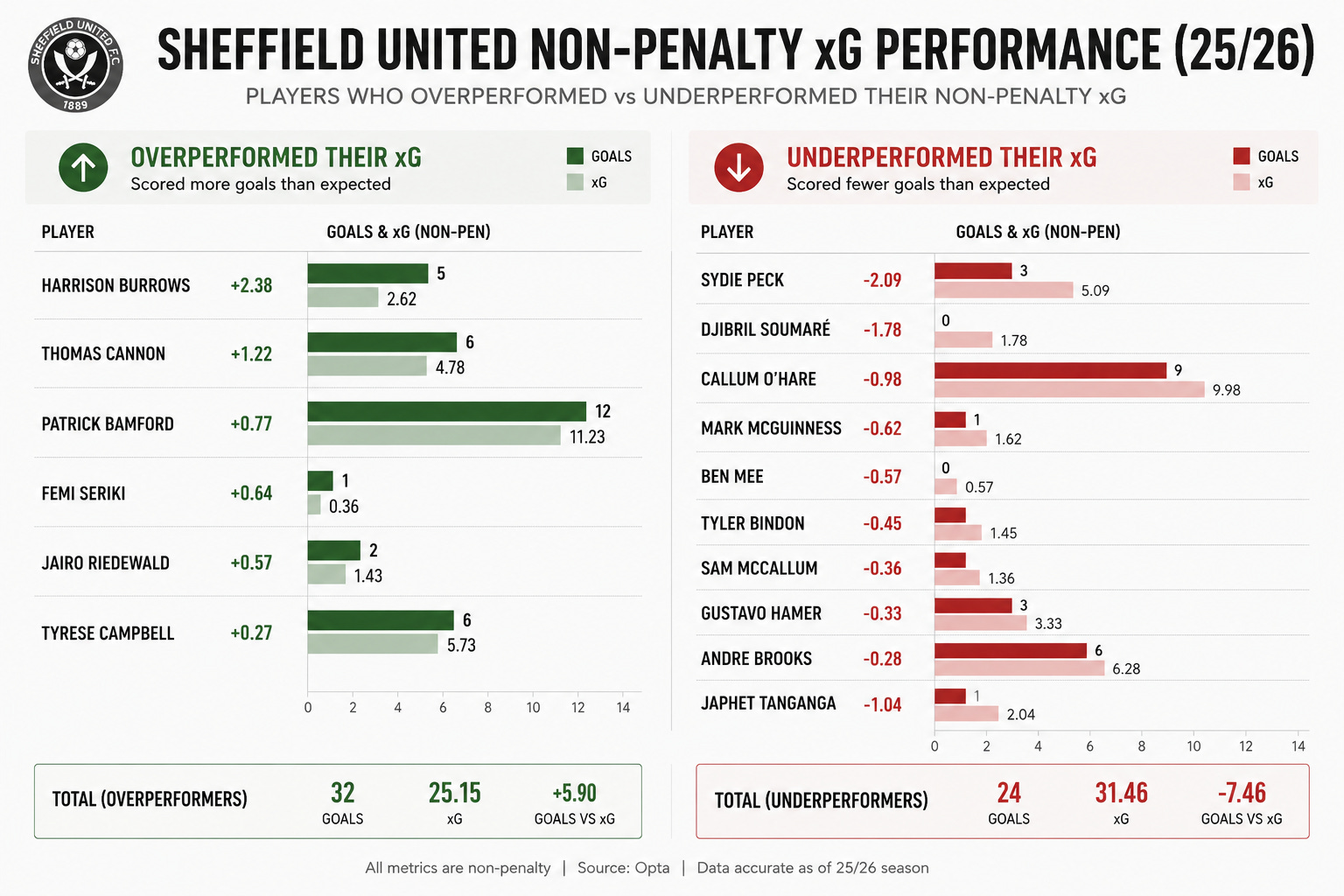
All our players, bar Bamford and Burrows, plus two strikers who didn’t play very much, a full-back who’s padding out his numbers with a worldie against Stoke and Jairo Riedewald, underperformed the chances they had. When you consider that we normally play one up top, there are actually very few finishers in this team at all.
On top of that, one of the things that simply must be flagged here is just how bad our centre-backs were at finishing the many opportunities handed to them from set-pieces. Sheffield United had the second-highest set-piece xG after Coventry last season, and scored just 16 goals from 21.44 xG. From 15.87 set-piece xG created by our opponents, we gave away 14 goals. We scored 5 headers all season! If we compare that tally with Middlesbrough, who had the 3rd-fewest headed all season, they scored 9. It’s not good enough.
But let’s not pin it all on the big, tall boys. The real issue was height across the team. Our squad composition is one of the worst in the Championship in terms of heading ability. Just look at the number of headed shots conceded (graph below): again, second worst behind Sheffield Wednesday.
“Too small?”
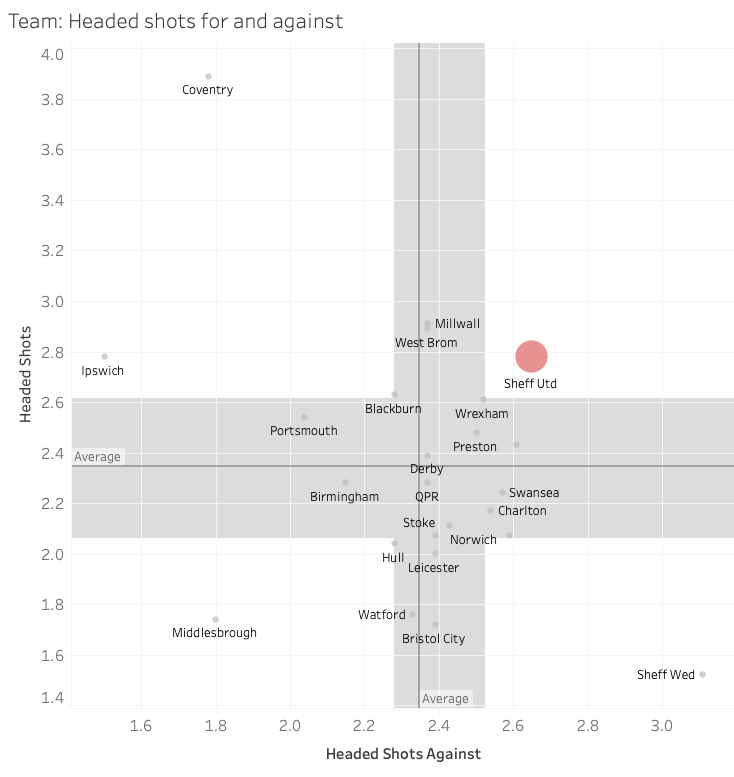
Clearly there’s a very simple solution to fixing the height issue: buy some big lads, and we stand to gain a huge amount in both boxes.
The other side of the finishing coin, and a positive note to (almost) end on, is that we can possibly factor in a few more good results next season based on the fact that creation is nine-tenths of the law, or something like that. That’s a very Brentford way of looking at it. But it hasn’t hurt them
Matthew Benham, Brentford owner, has said before that repeatedly getting into scoring positions tells us more about a player than whether they happen to finish chances in a small sample. Over time, finishing tends to regress. Chance generation is the more stable skill. And that is something we are very good at (fourth most big chances created last season).
Some encouragement then. Now, a miserable note to end on.
Conclusion
My advice to the Knill-less coaching team next year is thus:
Let’s recruit some better players
Some big ones
Some fast ones
And let’s try a few things tactically, like the odd early cross or pulling all our attacking players wide, to try and mix the build-up a bit
And let’s take a call on pressing; is it a net positive or negative?
And whilst we’re at it, let’s keep up the chance creation because that was good
And don’t forget the tall players
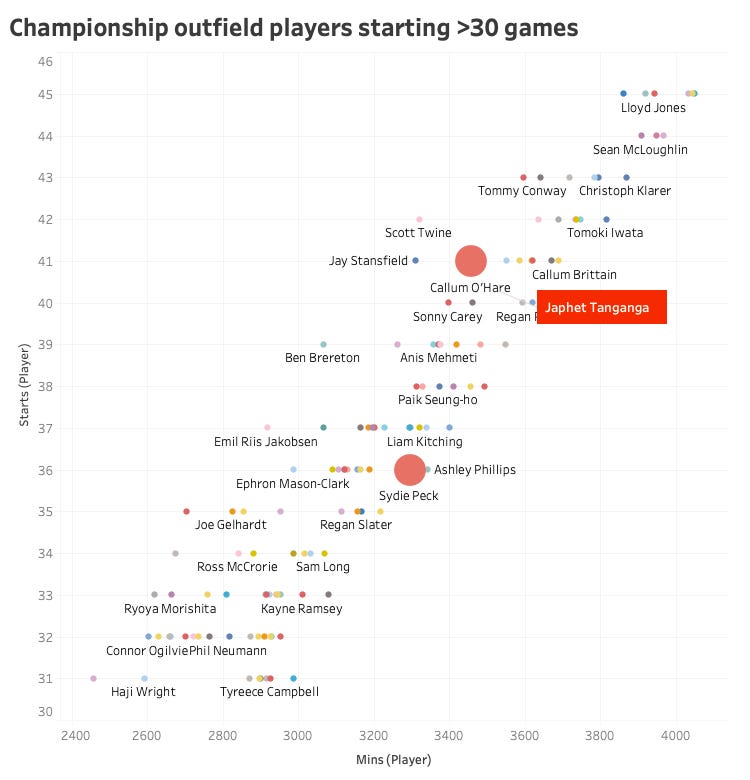
After that, I’d be saying to Mr Wilder that in an ideal world, we would settle the squad down. Because the final, and I think the most damning stat, is that only Callum O’Hare, Japhet Tanganga and Sydie Peck started more than 30 games outfield. That’s not a spine; we need to up that number to five or six, and that all comes before “fresh ideas” can be tested at all.
Jonesy, Collinsy, Prestidgey, McSheffrey-ey — over to you.
If you like this, please subscribe to The Pinch for free. Why not buy a fanzine and get a fanzine? Why not become a paid subscriber and help us out, but you don’t get anything in return, really.
Really interesting analysis, as usual, Sam. Our ability to win balls in the air suffered when Sam McCallum got injured. We don't necessarily need big players (though a Harry Souttar wouldn't go amiss). I understand Sam is fit again now, so if he can rediscover the form he showed at the start of last season, we might score much better on that front. UTB. ✌️😎⚔️
Good work Sam, as ever! While I don't have the knowledge to dive in as deep as these analytics, I do think it was clear that we lacked the ability to adjust in those games against the bigger teams. I wonder if we got away it more in the 90 point season, but a year later the squad was certainly in a mess, so without cohesion (in many forms ) this would also make sense.
I've found we haven't made use of certain strikers for years, there's the players to get into the box and cross and only Bamford has shown he can create from barely anything sometimes, but relying on a 32-year-old isn't ideal.
I wonder if a few of the same processes will continue but with the Knill switch out, Wilder will have to embrace not subbing people on 60 minutes regardless, and actually changing the system during the game, rather than hoping we'll hit people on the break, eventually...