


Sam Parry
It’s 50 shades of Brexit out here. Well, fifty-point-something. And the question on the ballot: Wilder In or Wilder Out?
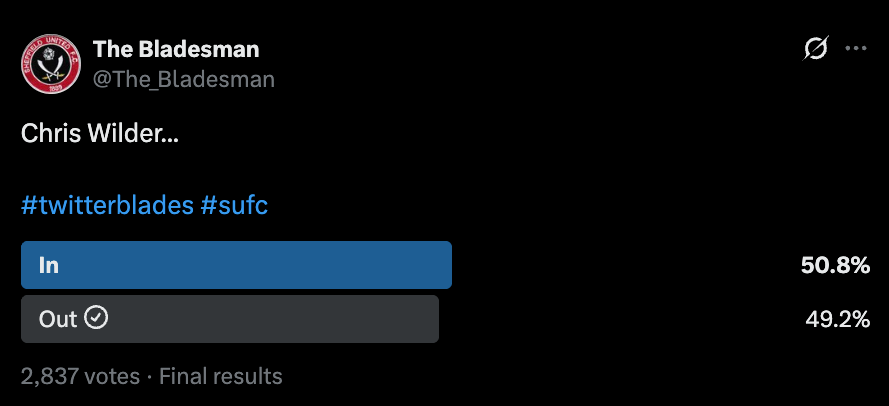
Like Brexit, the debate there’s as much emotion flying about as logic. Like Brexit, neither side can say with any kind of certainty what happens when they win. And like Brexit, I imagine most fans don’t appreciate the idea that they can be clumped together, and boiled down into loyal versus disloyal, positive versus negative, and in versus out.
We are all Blades. And I don’t mean that in a happy clappy way, but rather that any group numbering the thousands can simultaneously share wildly differing opinions whilst still being part of that thing we call being a fan.
It’s for that reason that I really don’t like referenda. Especially when, unlike Brexit, the future of the Sheffield United manager isn’t a democracy (whether it should be is a question for a different article). And whilst it’s not, the people who run the football club should use the information at their disposal, which is naturally greater than what fans have, to make good decisions. The fact they have failed miserably in that task over a number of years, through many different individuals and across many different decisions, is why we’re having this conversation at all.
We’re now two years out of the Premier League. We no longer have parachute payments as a crutch. And the clue was in the name because once you lose parachute payments, what goes up must come if not tumbling and crashing, then listing and floating downwards. That doesn’t have to mean down. But it could.
The team today is of a poorer quality than when Chris Wilder returned us to the Championship from League One. And whilst it’s tempting to characterise our decline as something that might’ve been avoided, I think fans – all football fans – are prone to projecting evitability onto inevitability. Since losing to Sunderland, the trajectory was only going one way.
So let’s take Wilder out of it for a minute. In fact, let’s take Sheffield United out of the equation altogether, because decline is a natural part of football.
Bad bets
The reality for most Championship clubs lucky enough to shuffle from second class, with its fake plastic trees and alpine air freshener, into plush Premier League First Class, is that they are sniffed out and put back in their place. For the majority of newly relegated clubs in the Championship, the whiff of a return is strong. For some, the one-stop bounce back is relatively easy. For others, it’s harder. For many, it doesn’t happen. There have been 24 Premier League relegation spells since 2010 where a club failed to return within two seasons, eight subsequently did get promoted, and 16 did not.
So it’s muddled, I think, to characterise the situation as pure failure. The reality that some teams don’t bounce back to the Premier League is baked into leagues; we organise the pyramid by tables and only three can go up. And whilst those who don’t make the grade (like us) can attribute their ‘failure’ to wrong turns and sliding-door moments, the truth is someone has to lose out. This year the teams with parachute payments include West Ham, Wolves, Burnley and Southampton. They can’t all go up, and that’s why it’s so staggering that people running football clubs so often bet big on a future that’s less Grand National and more National Lottery. But still, they do.
For at least one of those clubs, decline is coming, just like it came for us.
Of course, I’m not saying we couldn’t have made better decisions. In fact, I mean the opposite. It wasn’t inevitable that Prince Abdullah gutted any hope ahead of our last season in the Premier League. Nor was it inevitable that Kieffer Moore would give the ball away in the last few minutes at Wembley. We can point out failings of owners and players and managers and recruitment teams. We can criticise transfer business; that’s a problem. We could’ve signed better. We could’ve sold to different owners. Why did we sack him? Why did we hire him? What if VAR didn’t intervene? What if Bristol City hadn’t scored 4 from 4 shots on target?
I’m not suggesting that Sheffield United were forced into the decisions we made. What I’m saying is, in choosing to gamble on bouncing back, we wrote the prologue for a story that could only ever be great victory in promotion, or great decline in failing to get promoted. Was there another way?
Ahead of 24/25, imagine a world where we sold Hamer, Souza and Ahmedhodžić. Imagine the fans’ reaction if we’d released the brakes on the top-flight riches more slowly. Instead, we not only kept our highest-paid players but doubled down over the season with Jamie Shackleton, Sam McCallum, Kieffer Moore, Callum O’Hare, Harrison Burrows, Harry Souttar, Alfie Gilchrist, Tyrese Campbell, Michael Cooper, Jesurun Rak-Sakyi, Ben Brereton Díaz, Tom Cannon, Hamza Choudhury, Harry Clarke, Rob Holding, Jefferson Cáceres and Christian Nwachukwu.
We gambled. We earned 92 points. But Leeds and Burnley won that lottery; Sunderland nabbed the bonus ball.
The alternative arc on the decision tree was selling more and signing fewer players. No doubt I’d have called that path unambitious. You probably would have too. Because let’s face it, we all want to spend. If every transfer target was a referendum, they’d all receive a “yes” vote.
That doesn’t change the fact that the bet on bouncing back was a) the club’s bet, b) high risk, c) high reward and d) somewhat irresponsible. No doubt fans were happy to gamble. No doubt Wilder was happy to gamble - and that makes him complicit in the hand he’s been dealt today. And had we beaten Sunderland, the gamble would’ve paid off. But that doesn’t make it a good bet.
The risk was in making promotion the only measure of success. However good (or bad) the individual decisions in the transfer market, the gamble on each of them only paid off if we went up rather than if, you know, they were good transfer business. Selling Hamer to Leeds would have felt awful. I would’ve moaned on Twitter. But for the people running the club, would it have been a smarter decision to bank £13m?
The problem with “going for it” – with gambling on returning to the Premier League at the first or second attempt – is that a football club stakes its future on an outcome.
And that brings us to a huge paradox. Of course, I want us to do better, which in its simplest form means winning matches of football. But our dire situation today grew out of a desperation to win at all costs in the first place, at the expense of, for example, the unflashy building of a new training ground and the unsexy act of putting our best young players on long contracts.
We placed all our chips elsewhere and didn’t get lucky.
And this is the thing that frustrates me not only with the current owners and the previous owners, but the manager too: the difference between a good bet and a bad bet isn’t winning or losing. The difference between a good bet and a bad bet is the quality of your decision-making process.
And this informs both my critique of the last 10 years and where I place my vote in the Wilder referendum.
Pulling the managerial lever
It’s incredibly difficult, entirely counter-intuitive, and perhaps even impossible to forget the past when considering Wilder’s position. But it pays to look at today and not yesterday.
We could very well stay up. I don’t think survival is a ridiculously slim possibility. Neither is it off the table.
But if we go down, everyone will look at this season and see the hallmarks of a relegation. One-year deals. An older squad, full of injury-prone players whose career highlights are mostly behind them. Stalling assets who, at such a young age, have too much pressure on their shoulders. A lack of signings. A lot of sales. A lack of communication from the club about their expectations for the season. A strong whiff of desperation. A fractious fanbase. A fractious manager. Performances bottoming out. Players bottling it away at Fleetwood. And perhaps worst of all, the intangible gut feel of knowing that, on the pitch, Sheffield United are worse now than we were 10 years ago.
It’s all there in the tea leaves.
And the funny thing about clubs who are wedded to outcomes and not processes — clubs like ours — is that, if they fail to deliver promotion, afterwards they are left with fewer and fewer obvious levers to pull when things go wrong. Put simply: a financial situation that has to be managed so urgently it pulls the rug from under your feet.
The two obvious levers to pull are: 1) fire sale and 2) a managerial change.
The former has been pulled. But pull the latter, and none of us knows whether the hurtling car spins into a handbrake turn or crashes into League One.
I’m sure Leicester thought Ruud van Nistelrooy was the wrong man and then Martí Cifuentes was the wrong man, and then Andy King was the wrong man, then Gary Rowett was the wrong man, and now Russell Martin is the wrong man. I’m sure Luton thought Rob Edwards was the wrong man and then Matt Bloomfield was the wrong man and now Jack Wilshere’s the wrong man.
Maybe they were.
But it’s fair to say teams who double drop are always managed by the wrong men. How many managers do we want to sack to find out how far we fall?
If your answer is “just the one for now”, I wouldn’t be able to make a convincing argument against it. I couldn’t promise that things are going to get better. There are reasons to expect some improvement, which I’ll come to, but precious little in the football itself to inspire confidence. But we should be realistic about the fact that, whichever guy is in charge, we’re still going to need some luck: it’s far more valuable to Sheffield United that there are three worse clubs than us than it is imagining this squad can make drastic improvements.
None of that means to say Chris Wilder is the right man.
But if you agree with me that this season bears all the hallmarks of a relegation season, then you’d surely also agree that sacking the manager won’t, by itself, make them all disappear. Sacking Heckingbottom, after all, didn’t change a thing in the short term.
So is sacking Wilder now a good bet?
The main arguments I’d offer in Wilder’s favour look like this:
Every individual shuffling about the managerial job centre knows Sheffield United are in a bad spot this season. Quality candidates are hardly going to be knocking on the boardroom door if we sack him.
There’s a reasonable expectation that things should improve. Woeful as the football has been, when Femi Seriki, Harrison Burrows and Ryan Oné return, they will provide much better options and mean our bench is substantially improved.
There’s a reasonable expectation that a new manager would want their own players. In a season where we’ve already (loosely) backed Wilder to sign familiar faces, to change course and add to a bloated squad could make things worse (financially as well as on the pitch), not better.
It’s reasonable to have little faith in the ownership to make a constructive appointment. A bad appointment could easily leave us worse off.
It’s reasonable to expect a weaker team and a weaker performance level in the context of decline. That doesn’t excuse Wilder’s decisions, or mean he’s getting enough out of the players available. But it does mean judging him against what this squad can realistically do.
It’s reasonable to ask what a new manager could change with the players and resources available. A different approach might help. But before we sack Wilder, who at the club is a good judge of the footballing merits of Mr New?
But most of all: sacking a manager isn’t the only lever…
None of this means waiting forever to watch Rome burn. But sacking a manager in this situation, after eight games, is a touch too rich for my blood.
We’ve been too outcome-based; we’ve put too much faith in our bets paying off: now’s the time to think before we bet the house again.
Pulling a different lever
Why not, I dunno…
Bring in a coach? Bring in someone to take responsibility for recruitment decisions alongside the manager. Change approach on the pitch. Add a Director of Football or a Sporting Director or someone else to take the pressure off Wilder. Hell, bring in one good player in January.
Fans fixate on the idea that one man – whether it’s Wilder or not – can change the fortunes of a football club in a few short months. As I tweeted the other day, look at the talent we’ve lost over the last few years.

Is it not reasonable to think that departed coaching talent is just as consequential as the figurehead at the top of the club who, after all, can’t kick a football in anger? Is it not reasonable to think some of those names — from recruiters to coaches — contributed in the aggregate to so much of the success Chris Wilder delivered?
I don’t know. It’s impossible to measure. But there’s more we can do.
How about paying an external company to audit the way the club is run? We may not hear about it all that often, but many of the high-performing clubs across the EFL rely on outside expertise to recalibrate their operating model.
Is Bettis the right guy? Is there such a lack of footballing smarts at the club that Wilder is just stretched too thin?
The idea that one manager is the problem and another unknown manager is the solution oversimplifies a much more challenging picture. But at the same time, I wouldn’t disagree there’s an on-pitch problem.
I hate the football we’re playing. I hate the performance levels. And maybe a change can make a world of difference. I hate the recruitment. I hate that Wilder cited David Moyes’ Everton from 20 years ago as a model club. But sacking Wilder now wouldn’t change the structural issues at the club.
So my answer to the Wilder question — in or out? — starts with what we’re asking him, or anybody else, to do. If it’s just the expectation of one man being in charge whilst a club contends with the gravity of failing to bounce back, then we’re asking too much of one appointment.
Gravity, as Radiohead put it, “always wins.”
Wilder out is inevitable
And Thom Yorke, wrong about much, was right about that. Because however you view the situation today, eventually the answer to the Wilder referendum will be “out”.
Wilder has been part of too many gambles because that’s the task the club have given him - but it’s also what he and fans wanted too. He was the moonshot that took us to the moon, the bet that won, the numbers coming up.
We’re not in that situation today. Making new and better bets requires a process-driven approach. A process-driven approach requires new thinking. New thinking will, eventually, mean a new manager because it’s just not in Chris Wilder’s DNA to be the guy who builds success in increments. I don’t want a plan that depends on Chris Wilder changing his DNA. I want to change the manager when the structures are in place that mean managers can come and go without the whole club lurching from one chaotic but successful spell to another chaotic but unsuccessful spell.
That’s not too much to ask. Other clubs do it.
In fact, isn’t this the great lesson from the often-cited Brentford, Brighton and Bournemouth model?
Whilst rich owners are a huge help, what sets them apart is a process-driven environment where club employees outlast managers, where collating information improves the chances of winning every bet, and where success is found in the aggregate, not the work of one man doing great deeds.
Their identities didn’t happen overnight. They were built through years of planning and good decision-making. And like Brexit, so much of this is about identity.
Wilder has been our identity for the best part of a decade. That’s a tribute to what he achieved, and a problem — or at the very least a consideration — the club should have spent that decade thinking about.
Eventually, there will be a Sheffield United without Chris Wilder. The task is to build a club that knows what it’s doing when that day comes. So sack Wilder, or don’t sack Wilder. Just don’t mistake either decision for a plan.
And btw, that’s a spoiled ballot.
Enjoyed this. Agree with most and smells of Warnock too for me.