

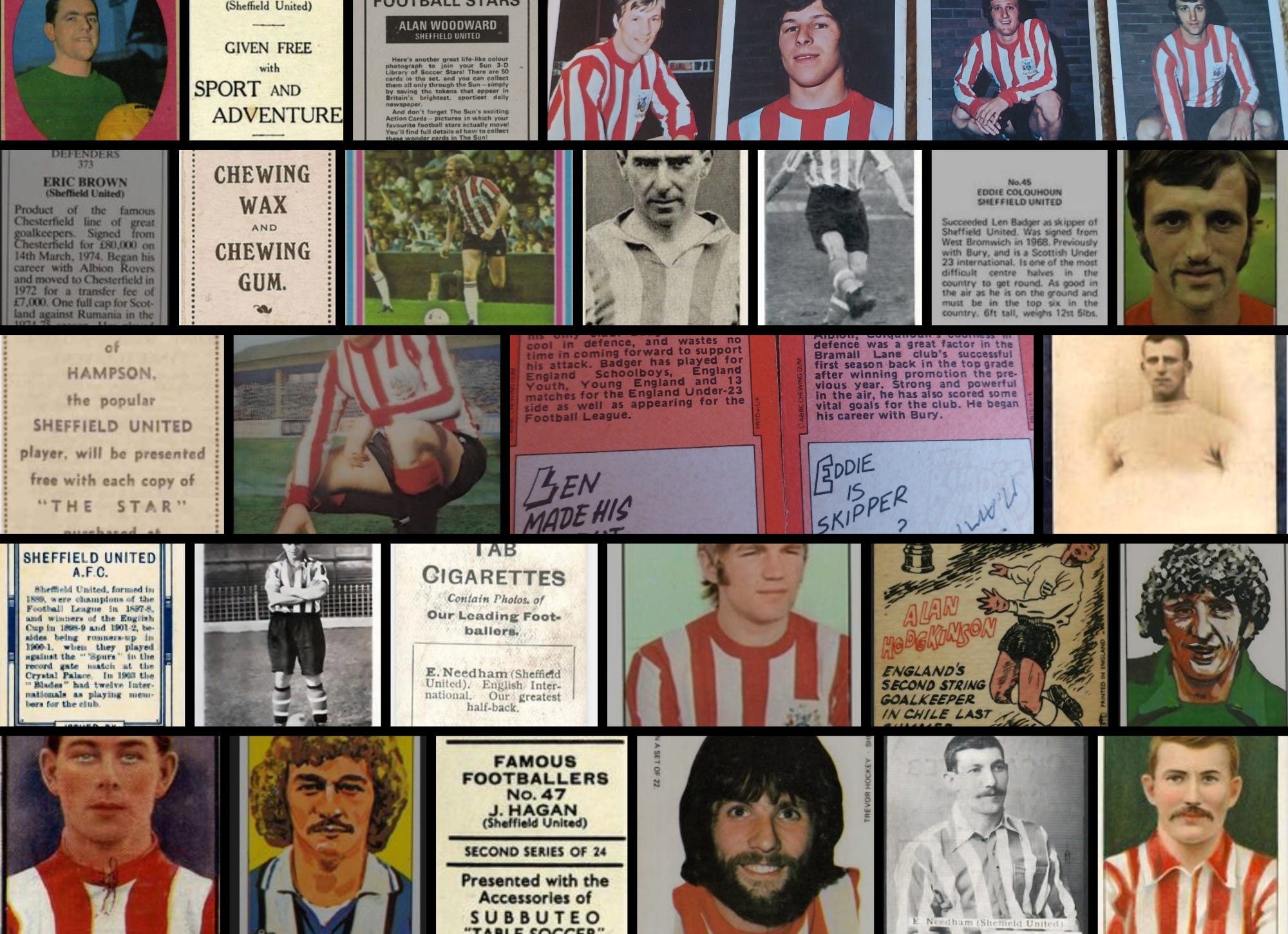
A History of Sheffield United through Cards and Stickers: 1897–2026
BY DEADBAT
Football stickers are enjoying a huge renaissance. Fierce licensing battles between the giants of the industry, Panini and Topps, have peaked in tournament years. However, even in our domestic league the rebirth of the adhesive collecting experience has filtered down to our own football club. Digital integration, premium finishes and the vast array of cards and stickers have inspired a new breed of collector.
As a man firmly entrenched in middle age, I perhaps should not be excited by the vision of a shiny sticker, but here we are! Having children provides an ‘excuse’ to purchase the World Cup sticker albums or the Premier League books where you can try and collect as many England or Sheffield United players as you can.
Of course, the collection of small, wallet-sized images of footballers has not been restricted to the sticky type. Cards in cigarette packets, periodicals, magazines, and newspapers have documented the changing face of our national game. Trading cards have become a fierce and lucrative industry in their own right. My personal collecting experience began in the mid-1980s through the aforementioned Panini, with a simple badge or team sticker. As United climbed the leagues you could really expand your collection with whole squads available. Latterly, card collections such as the ProSet series would further dent my Mum’s bank balance.
I started to research the hobby of card/sticker collecting and ended up down so many rabbit holes but I tried to focus specifically on the Blades and their own history. I was surprised to find there had been close to 5,000 individual cards and stickers produced in connection with SUFC. This number has grown hugely after our three spells in the top flight since the turn of the millennium when a myriad of card and sticker types are produced for Premier League clubs.
Part One: The Birth and Death of the Cigarette Card
1897–1937
In the 1870s, tobacco companies began inserting blank pieces of cardboard into paper cigarette packets to protect the cigarettes from being crushed. These ‘stiffeners’ soon were to be used as prime advertising spaces. Companies then evolved such advertisements into collectible pictorial sets. These attempted to foster brand loyalty and, because the primary consumers were working-class men, it was an obvious decision to use football, and footballers, on such cards. At the time, writer Arnold Bennett remarked that “some boys will grow up with cigarette cards as their sole education”. Another writer, Clifford Hough, pointed out that cigarette cards were dubbed “The Working Man’s Encyclopaedia” because “they brought pictures of famous faces and fascinating places” to the attention of the masses.
Ogden’s Limited was based in Liverpool and pioneered the inclusion of black-and-white real football cards in their ‘Guinea Golds’ brand.
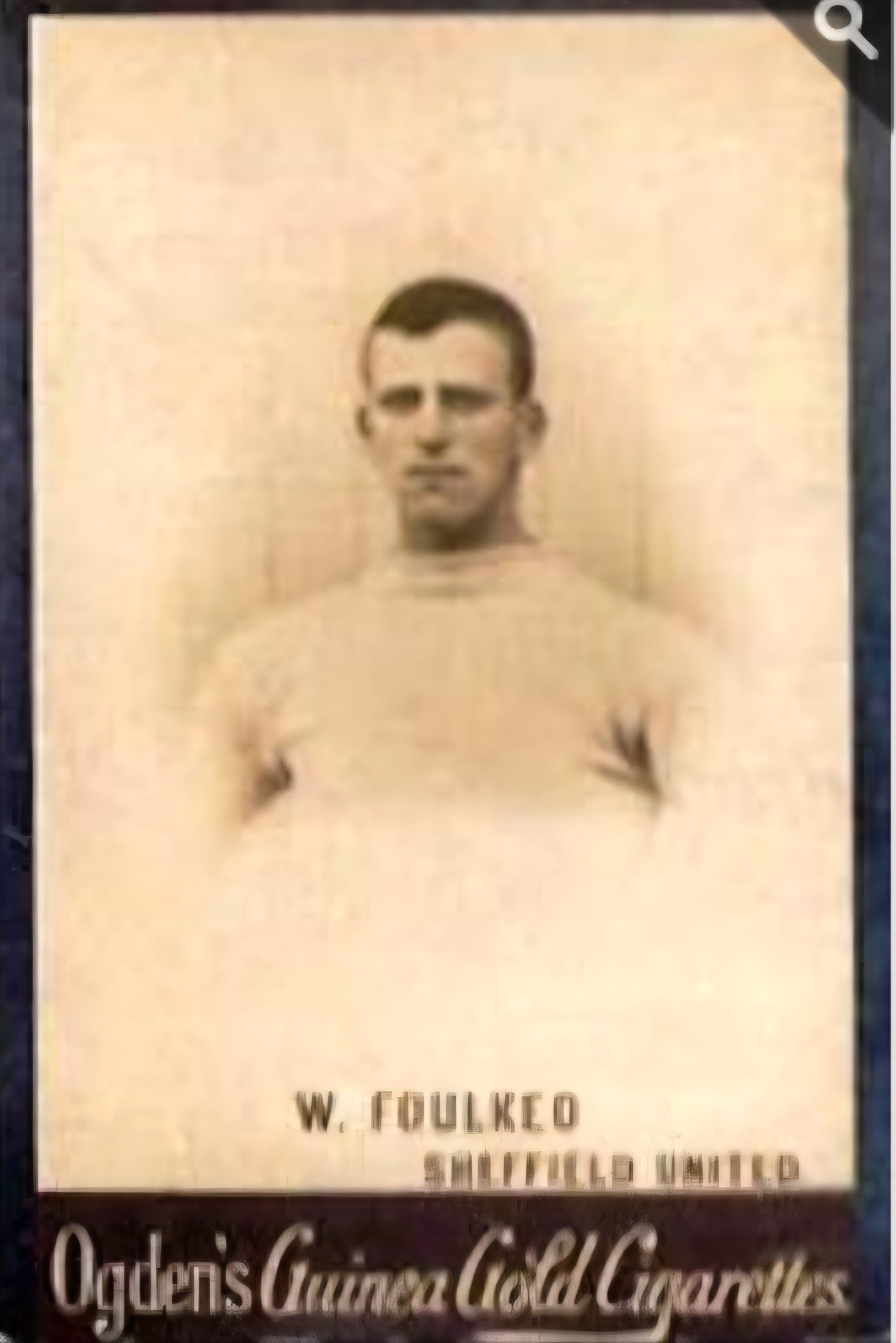
Ogden’s produced the first Sheffield United card/sticker ever with their William Foulke card in 1897. Sadly, they spelt the legendary goalkeeper’s name wrong – listing him as W. Foulked. You could say it was a bit of a Foulk up!
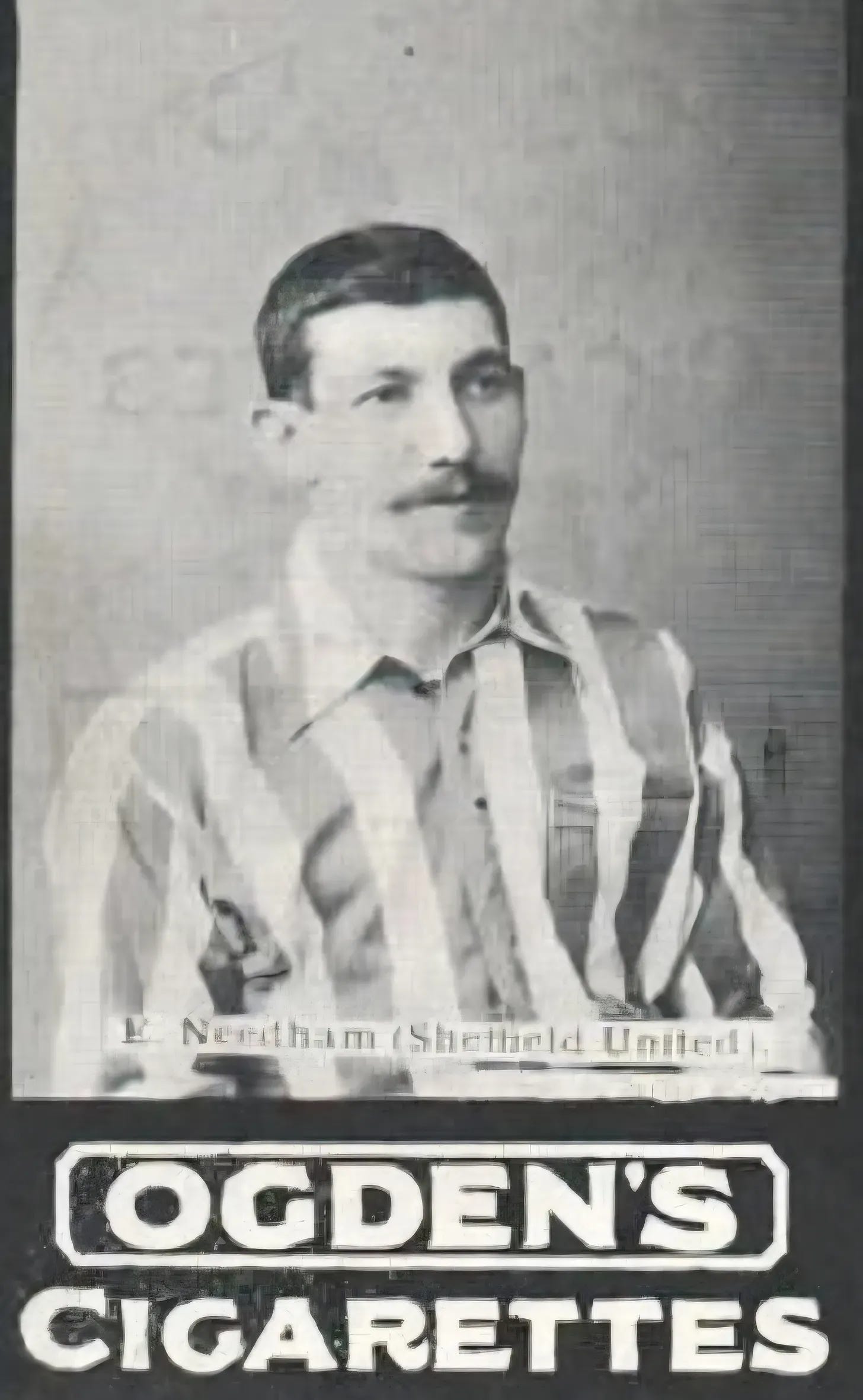
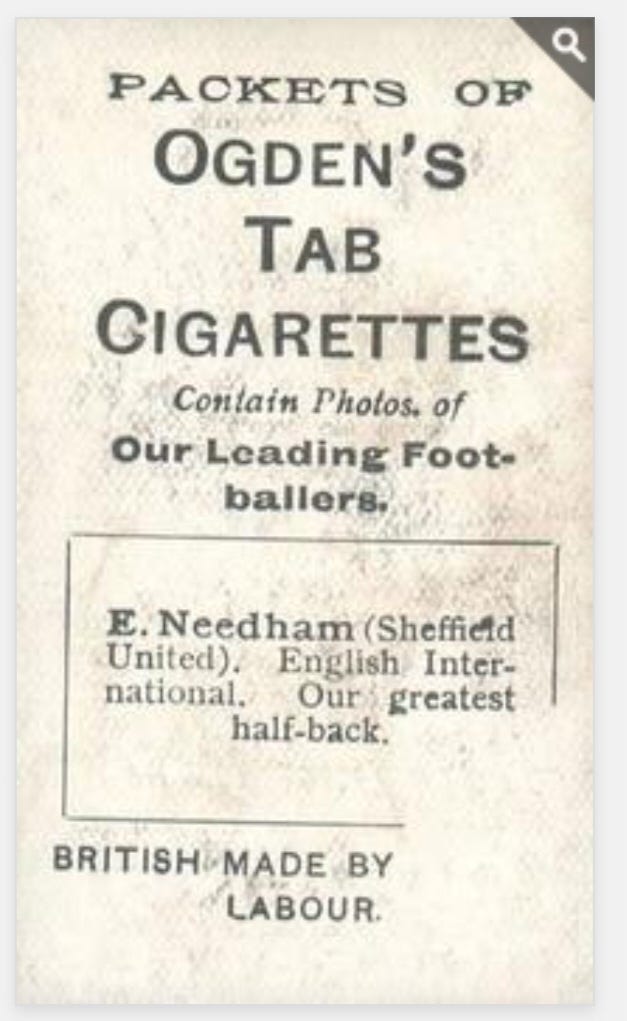
W. D. and H. O. Wills were the first company actually to issue cigarette cards and brought out sets such as Ships and Sailors, Aviation and Butterflies before moving into football. They produced a series of “Our Leading Footballers” (1901) and included United players Harry Johnson (son of our all-time leading goalscorer) and Ernest ‘Nudger’ Needham. This set is extremely rare and highly collectable, with single cards still fetching up to £100 or more.
There were a number of companies that quickly followed suit, such as Marcus and Company, with the first dedicated football set, titled Footballers and Club Colours. They cleverly used painted chromolithographs to avoid paying copyright fees to professional footballers. Three Bells Cigarettes and Wills Woodbines produced sets in 1902 depicting Blades players, many of whom were England internationals, mostly in suits. In 1906 Ogden’s produced the first colour card for Sheffield United.
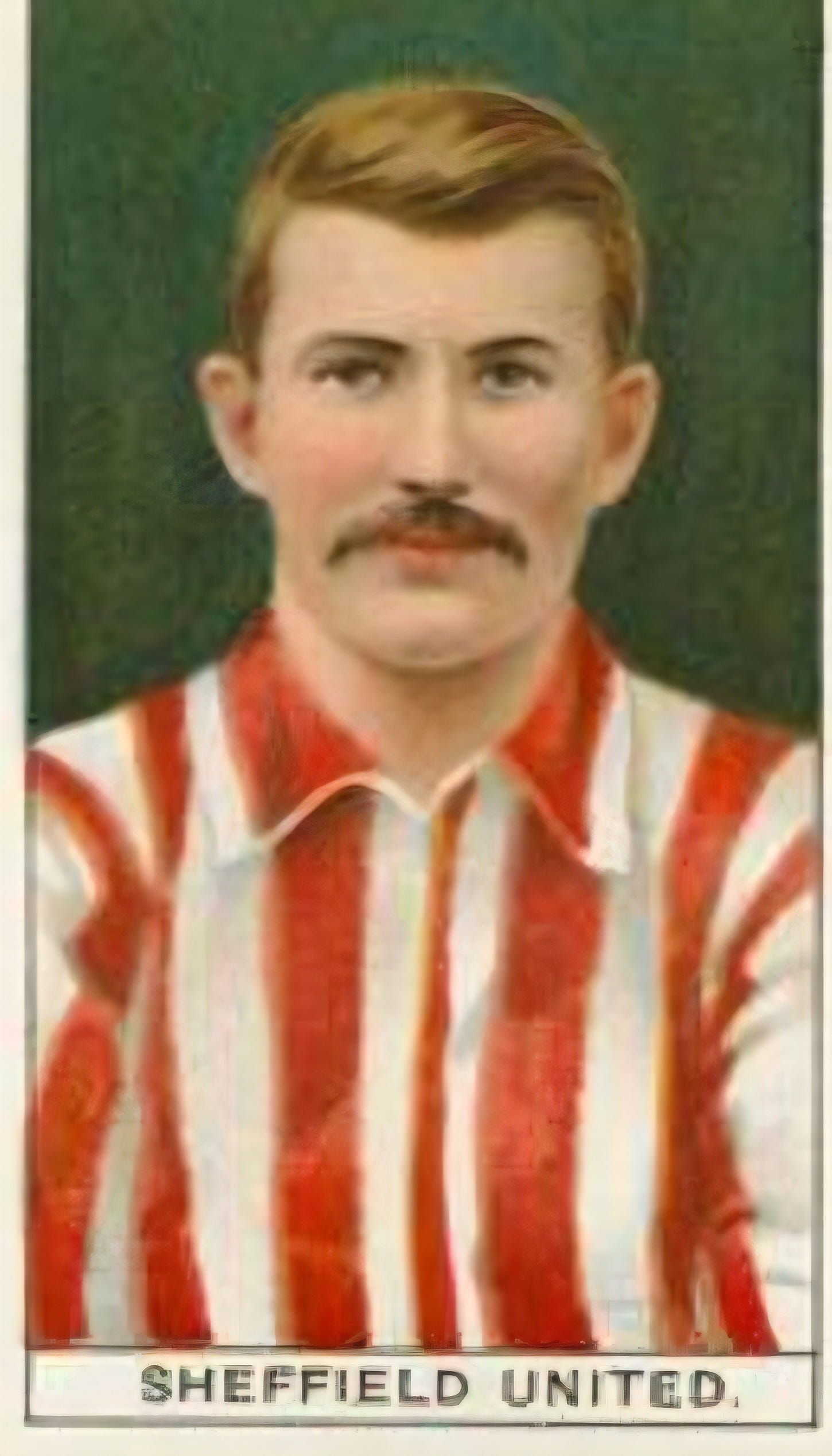
Taddy and Co. released its prominent footballers series and Cope Brothers released sets of Blades players between 1906 and 1914 before Churchman’s Footballers and Godfrey Phillips gave another dash of colour to cards. Images were mainly individual photos of the face rather than full-body or action shots. There were a number depicting players in suits rather than their kits too. Of course, the First World War meant there was a period during which production became limited, but in 1922 cards were given out in periodicals such as Sport and Adventure and Boys Magazine.
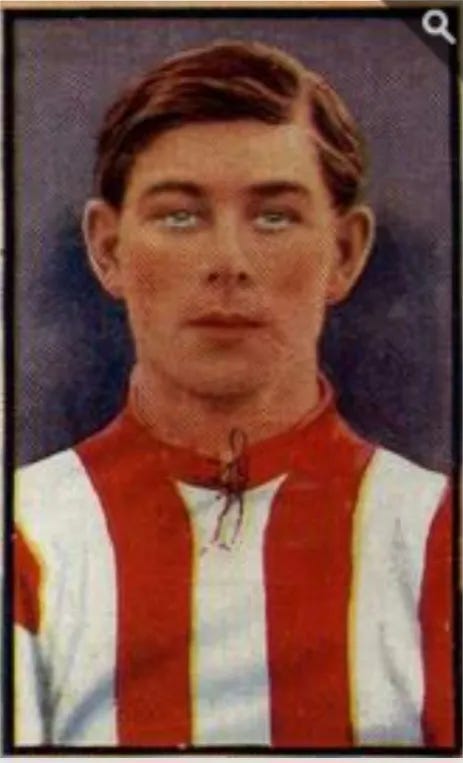
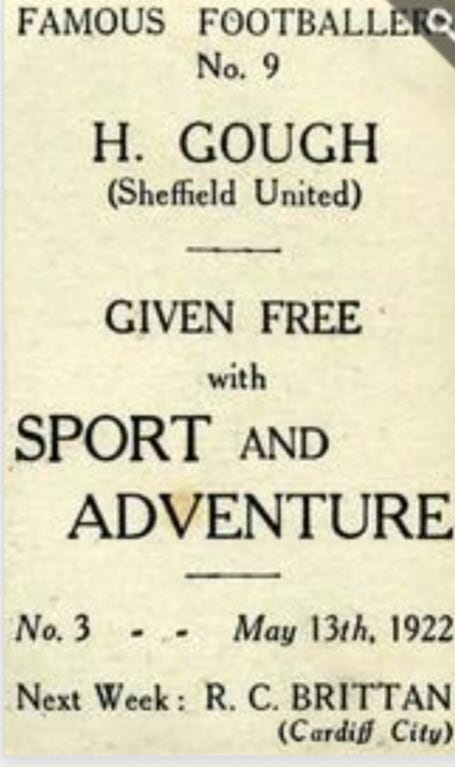
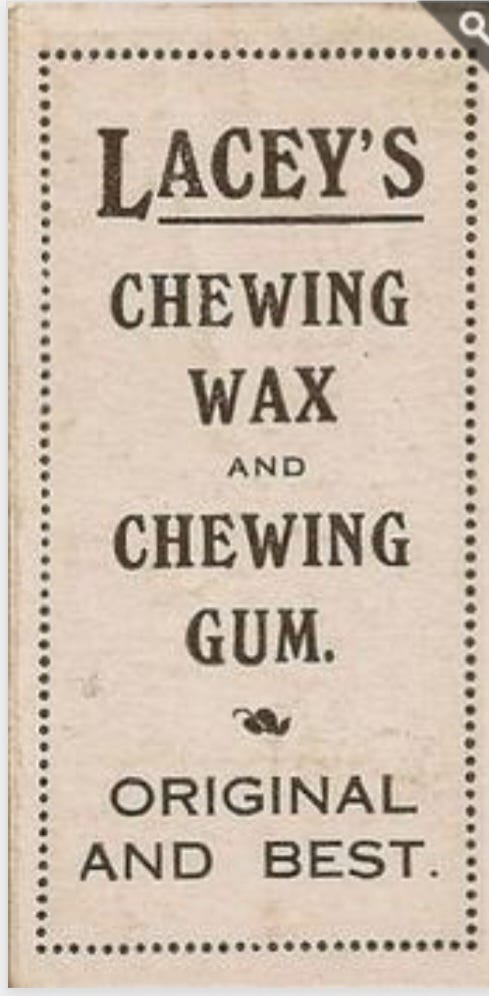
British American Tobacco became prolific around the mid-1920s, a period that also saw sweets and chocolate start to insert cards, with Crescent Confectionary being one such company. Lacey’s Chewing Wax and Chewing Gum also came to the fore, with United luminaries such as Fred Tunstall and Billy Gillespie featured.
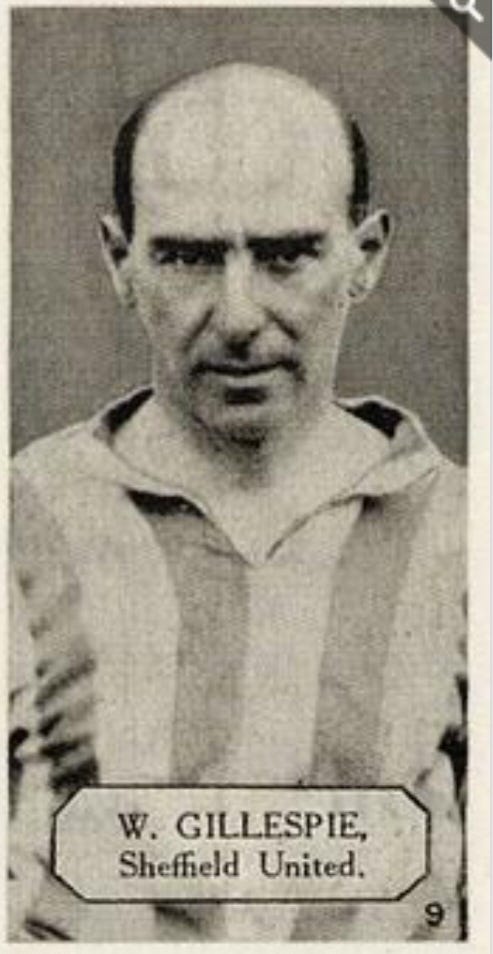
The first cards were produced by Barratt and Co, a company that were still producing cards right up to the late 1980s. The well-known Lambert & Butler and John Player & Son were also involved in production. We saw companies such as Ardath produce caricatures of players and also painted portraits – which looked so realistic they appeared to be painted photographs. It was around this time that tobacco companies produced special albums that could be purchased from local tobacconists. This was to encourage the collecting of a particular series.
Production was scaled up to the extent that the cigarette manufacturers used dedicated in-house design and art studios.
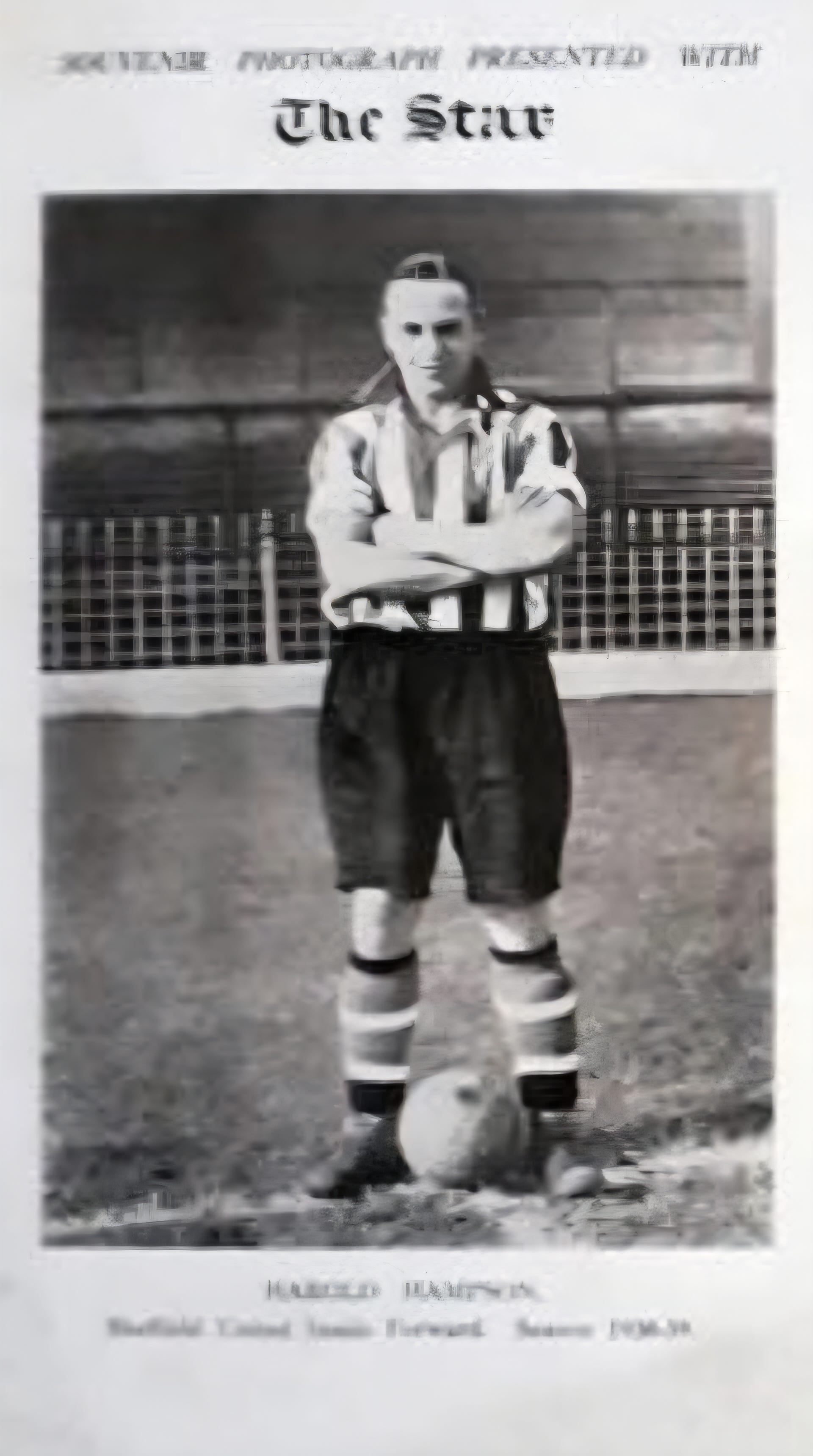
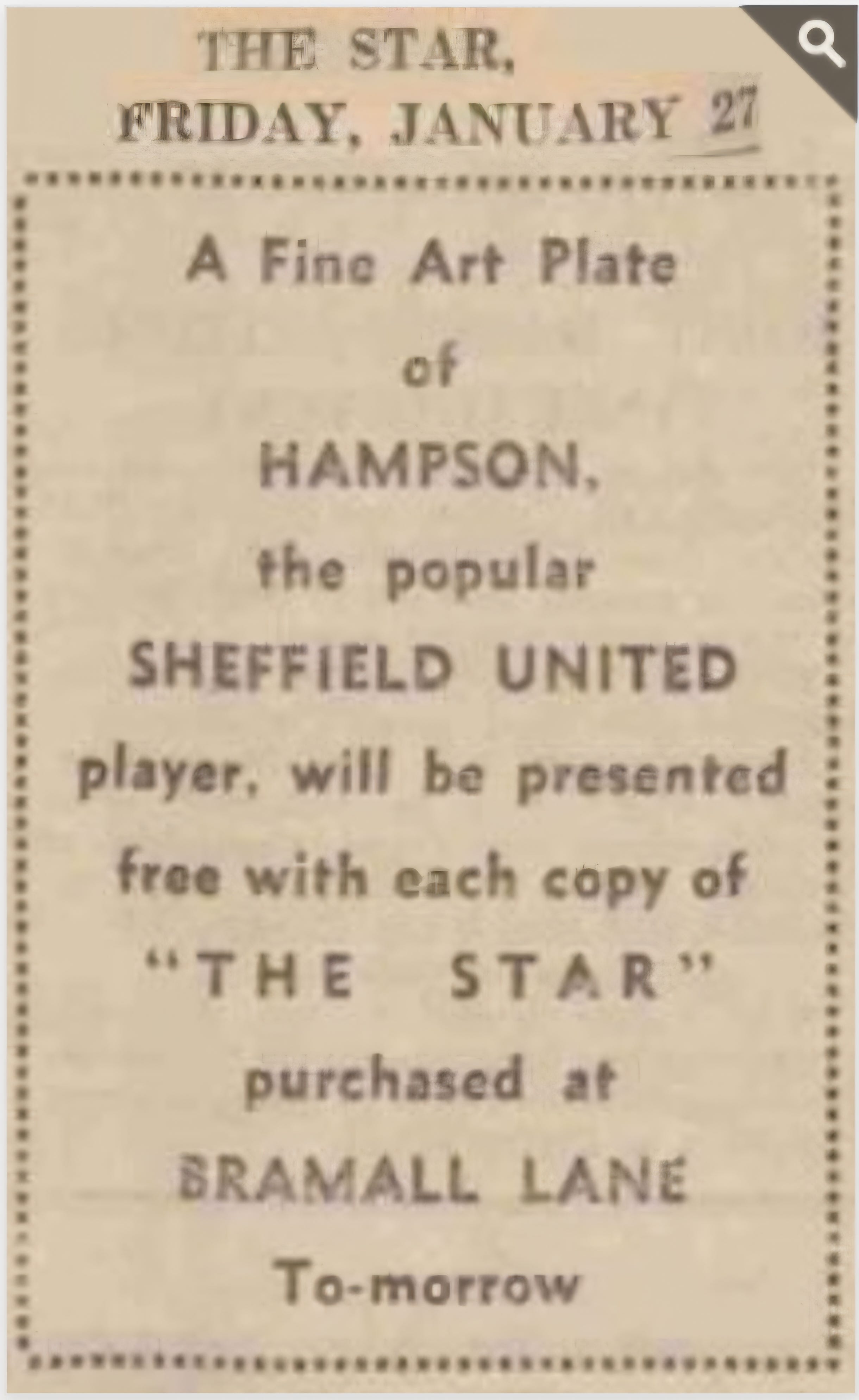
Local newspaper the Sheffield Telegraph and Star joined in, giving out small photographic cards, free with each copy of the newspaper bought at Bramall Lane.
R and J Hill and the Topical Times magazine were two of the final purveyors of the football card before the outbreak of the Second World War.
The war brought a swift and permanent end to the traditional cigarette card. In 1940, the British government imposed strict paper rationing to support the war effort. Tobacco companies were legally prohibited from including cards in their packaging. When the war ended, ongoing economic austerity and the cost of materials meant companies never resumed inserting free cards into cigarette packets.
Part Two: Trading Cards & the Introduction of Football Stickers
1945–1985
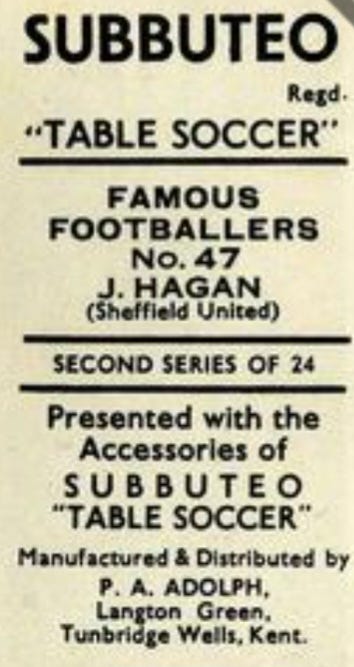
Cards were still produced but tended to be packaged with sweets, bubble gum or chewing gum, such as Chix confectionery and Cadet sweets. Barratt and Wills continued to be at the forefront but the table-football game Subbuteo also issued cards via sales of accessories. Jimmy Hagan was number 47 in the famous footballers series in 1954.
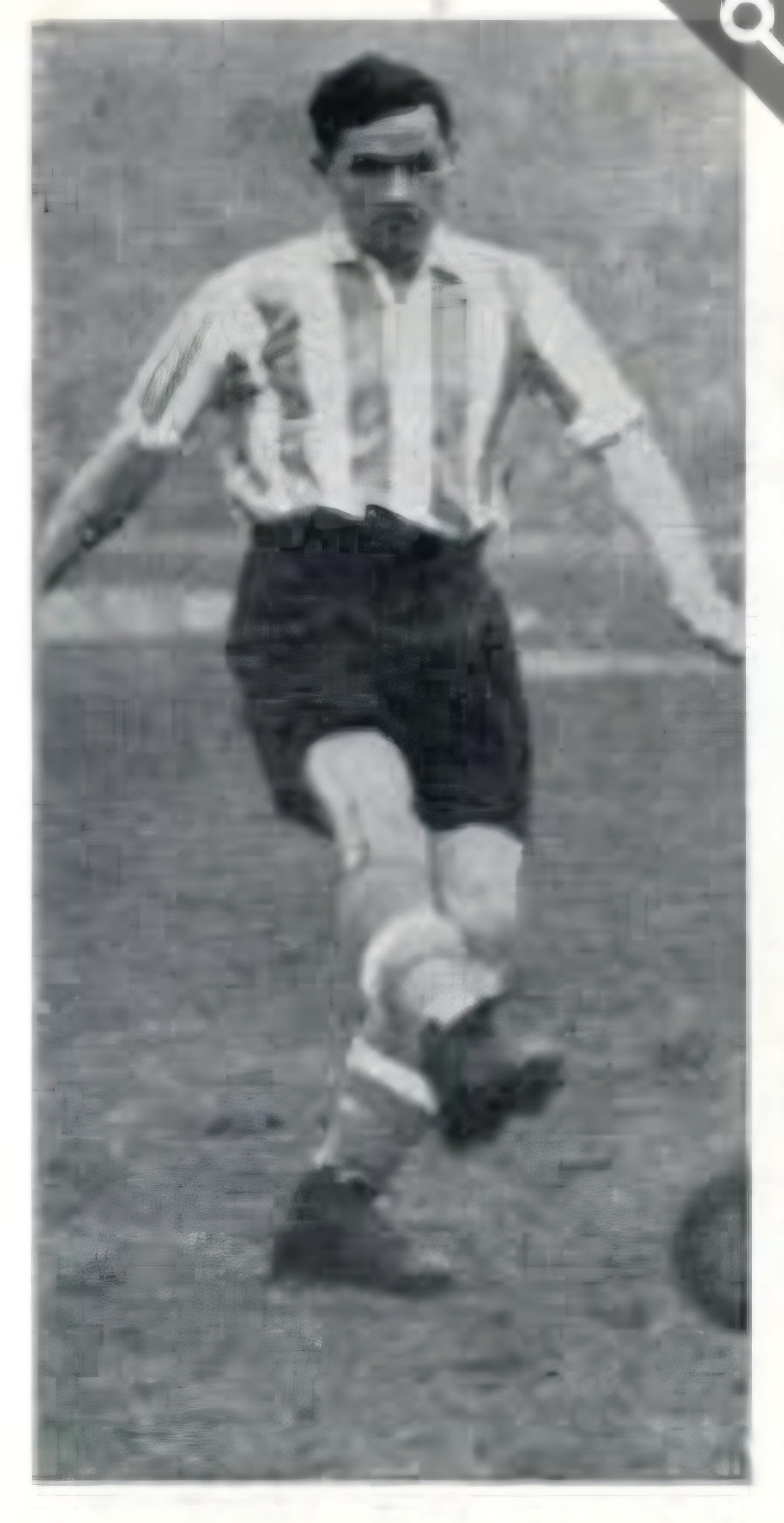
Moving into the 1960s, A&BC chewing gum and other food sources such as Clevedon Confectionary & Quaker Oats came on board. At this stage the cards were quite varied, with some illustrations, some photographs and some cartoon versions being produced.
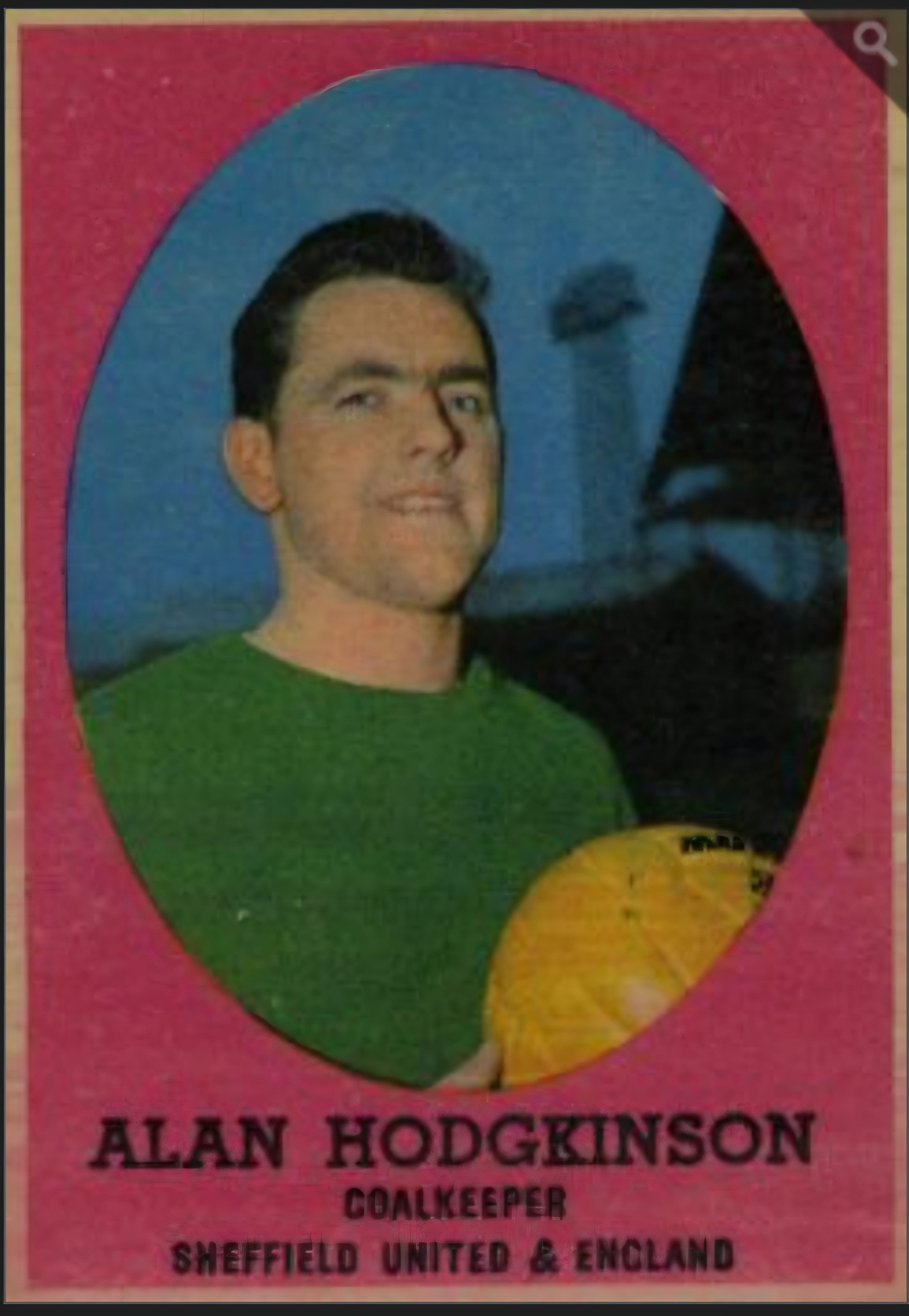
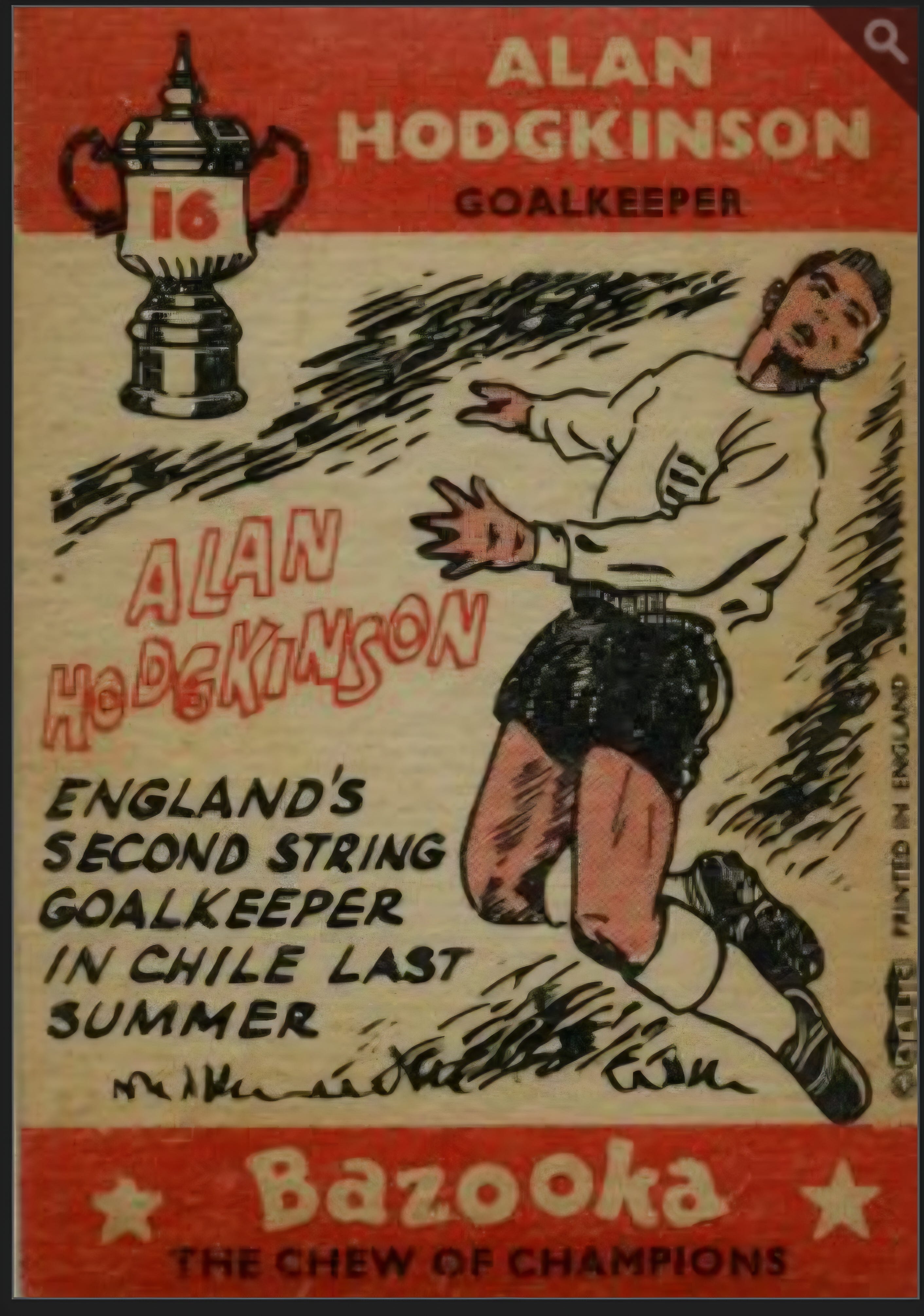
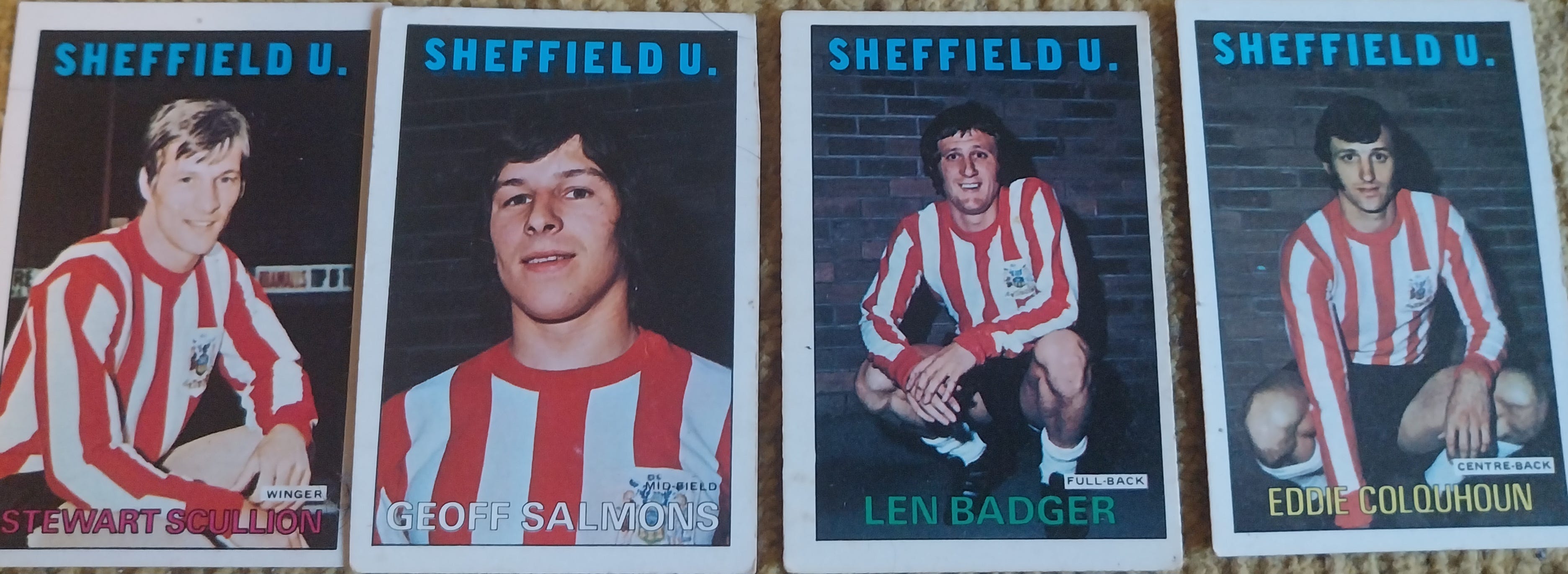
Around 1967–68, the first stickers involving Sheffield United were produced. The FKS Publishing company had a series entitled ‘The Wonderful World of Soccer Stars’ and our entire squad was featured. Although even these were not stickers in the true sense of the word, having to be fixed into the slots in albums, using glue!
Heading into the 1970s, a successful period for John Harris’s famous Blades side, we saw United being one of the most talked about teams in the land. Indeed, Marshall Cavendish depicted us in their top teams series.
It was in the early 1970s when perhaps the most famous sticker/card company to produce football memorabilia came into the public eye. Panini. Founded by brothers Giuseppe and Benito in Italy in 1961, they were the company that made the football sticker, and the albums they were inserted into, so famous. It was Panini that pioneered self-adhesive stickers and their first tournament album appeared for Mexico 1970.
In terms of Sheffield United, the 1971–72 season saw Panini release a full set for the club with the famous side of that era all depicted. They also had a Top Sellers series in 1972–73 which once again saw a full set of United players used.
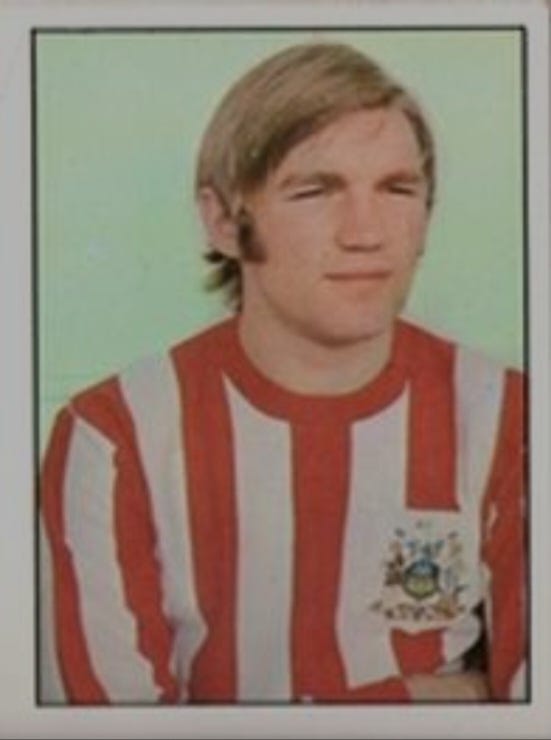
There were still other companies jostling for position despite Panini’s entry into the market. Cards continued to be popular despite the sticker explosion. The A&BC Red Back cards featured detailed player biographies that then had a quiz question to check you had read the description.
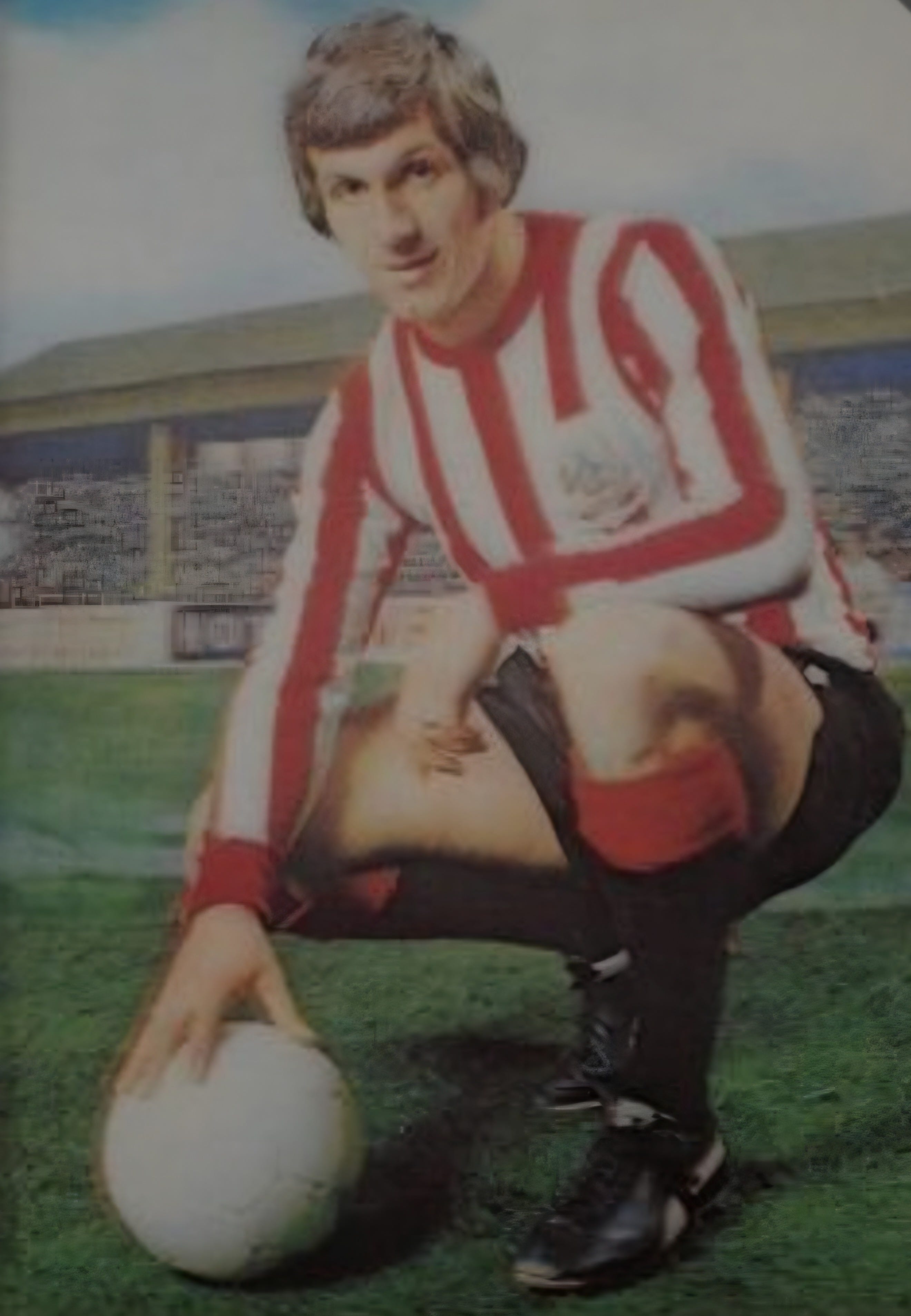
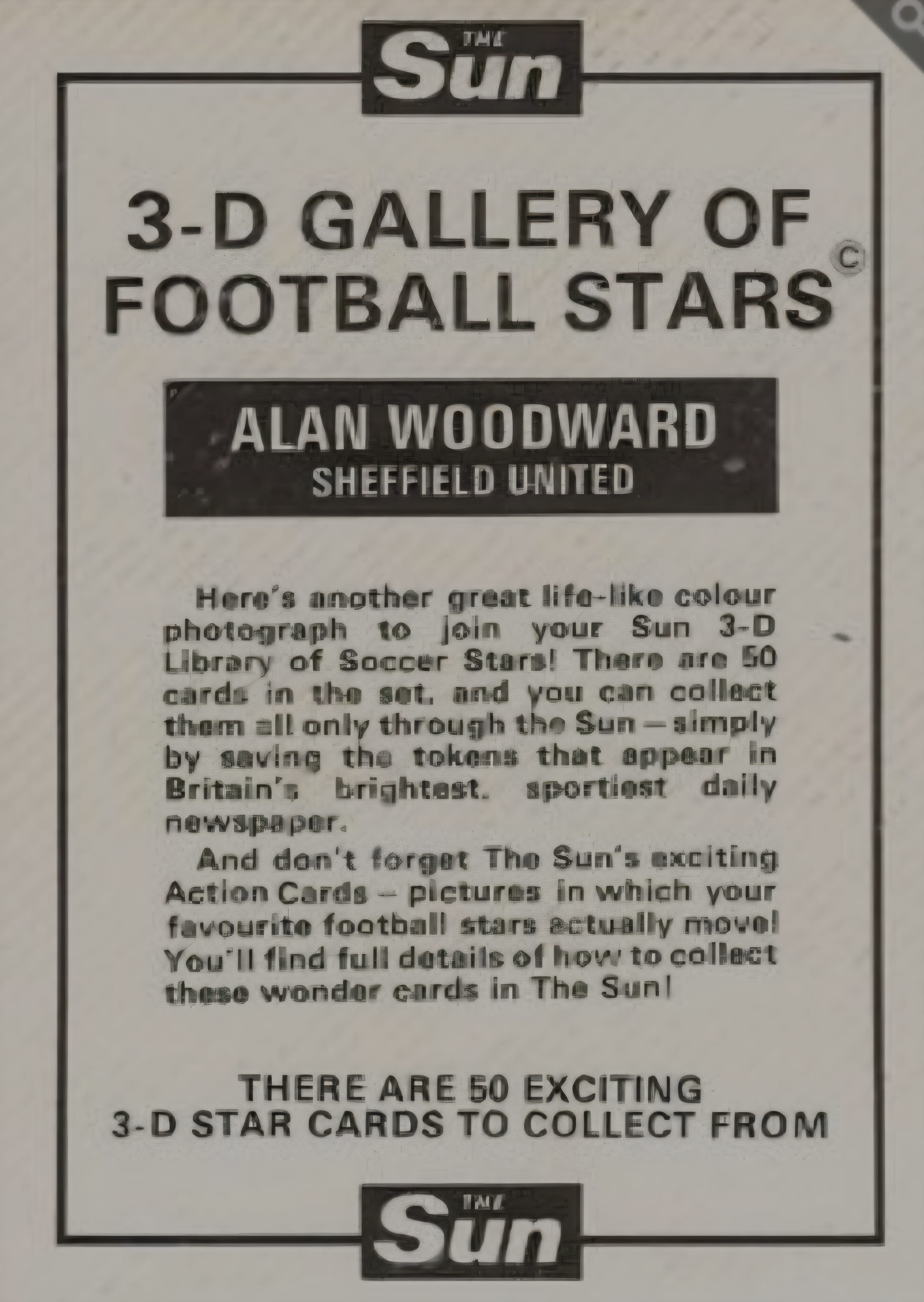
The Sun newspaper produced 50 exciting 3-D Star Cards, with Alan Woodward chosen as our lone representative, making it even more galling he never won an England cap!
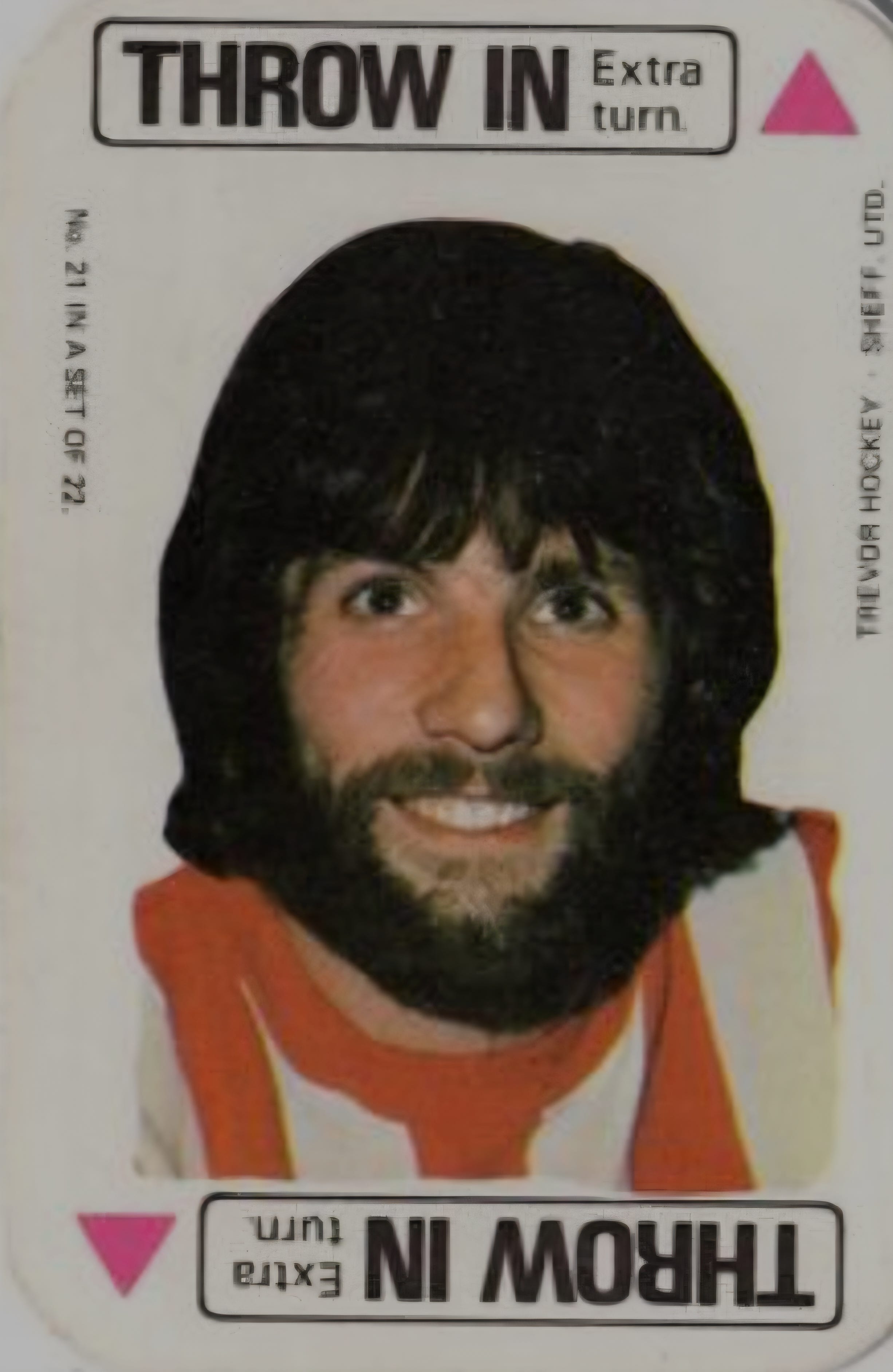
A&BC continued to be trendsetters when they adopted a Football Card Game. These game cards listed specific abilities or a numbered rating (like speed, passing, or shooting) assigned to a player, which dictated who won each round of play.
The same company continued with their individual player cards, but team badges also appeared for the first time – surprisingly, they had not been adopted before. Similarly, team photographs had not been commonplace on stickers or cards, with the focus being on individual head shots.
Americana was a German company, and its Soccer Parade series was introduced, and also in the mid-1970s, Barratt and Co made a return in terms of involvement with the Blades. This perhaps did not come as a surprise, as the company’s headquarters was now in Sheffield, being part of the Bassett group – which was based across the road from our city rivals in Hillsborough.
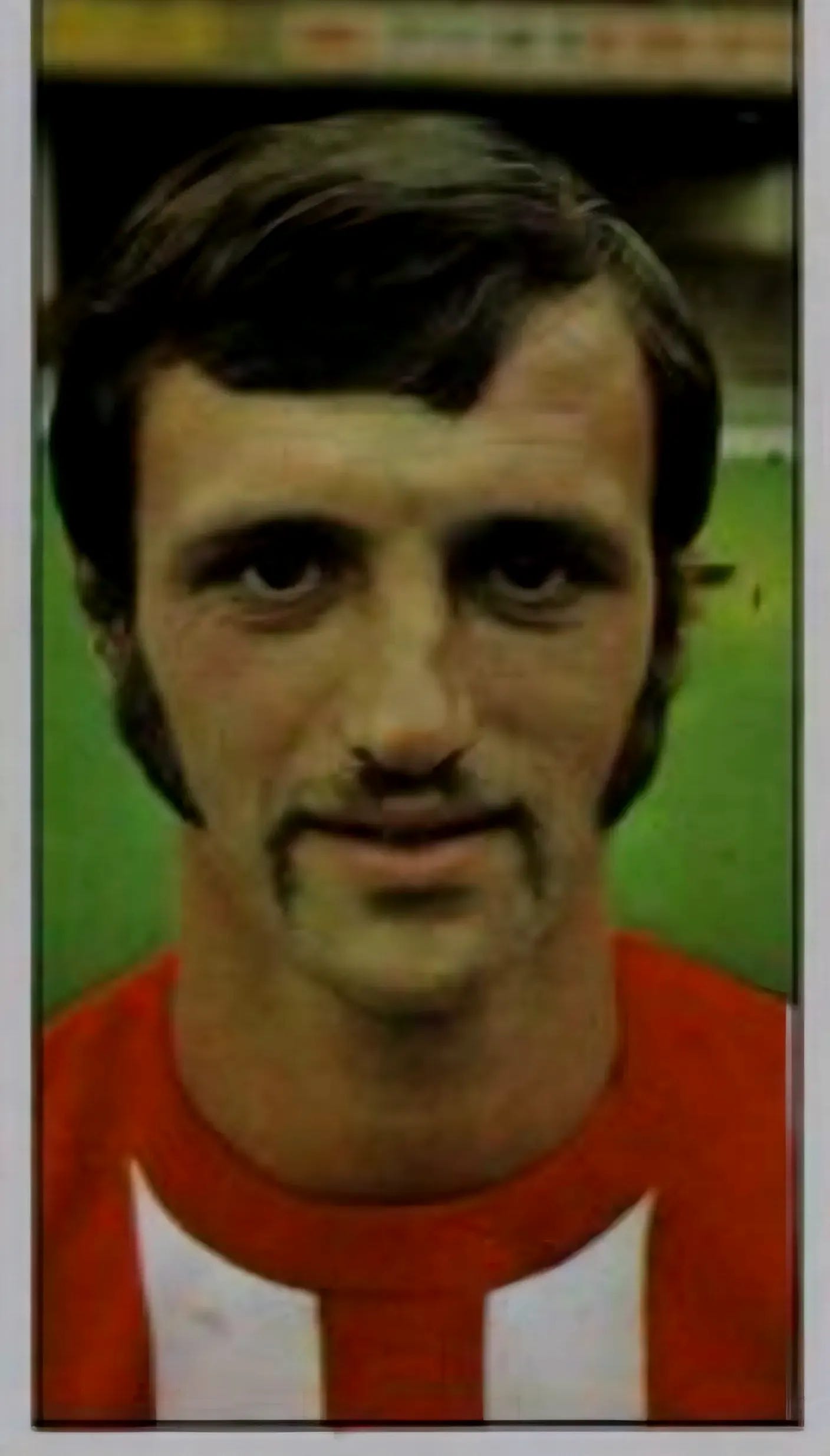
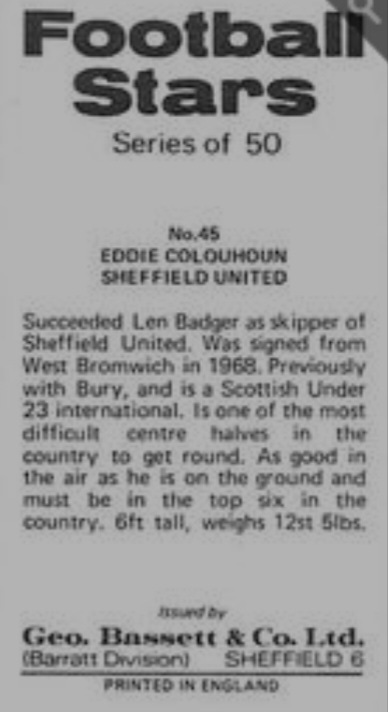
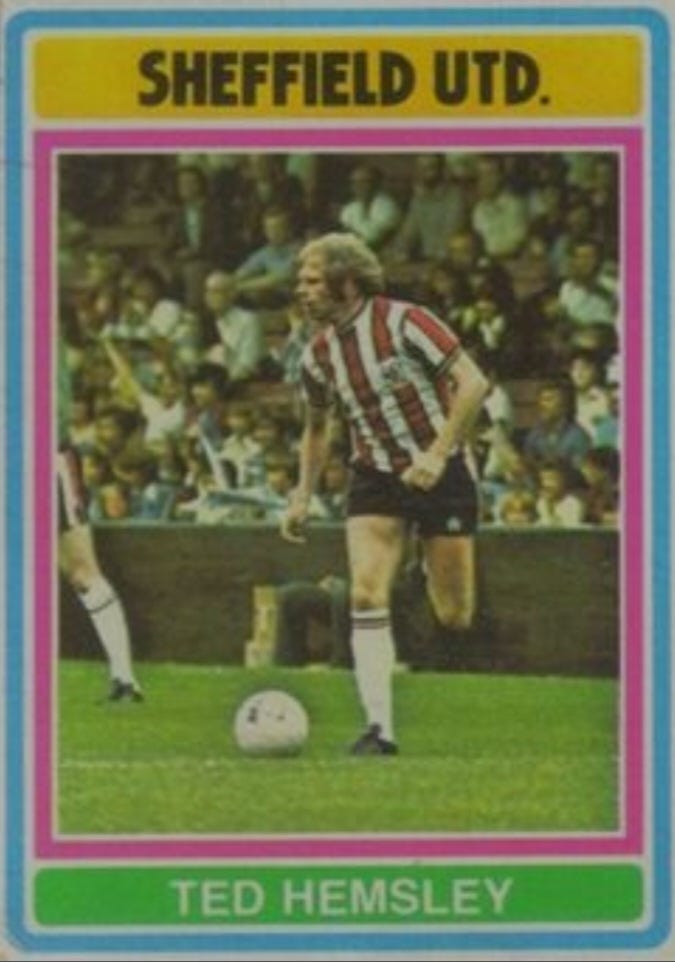
FKS continued its battle with Panini and tried to produce postcards alongside stickers and cards. A new company, at least to our shores, popped up in the mid-1970s. Topps were an American company founded in 1938 in Brooklyn and had produced American Football and Baseball cards in the States, but started to dip its toes into the market after seeing a UK market from which it could profit. Following legal battles, the Topps Company acquired A&BC and launched their own Topps-branded English football sets, primarily printed in the US and Ireland. Topps also started to introduce more action shots, featuring players on the pitch.
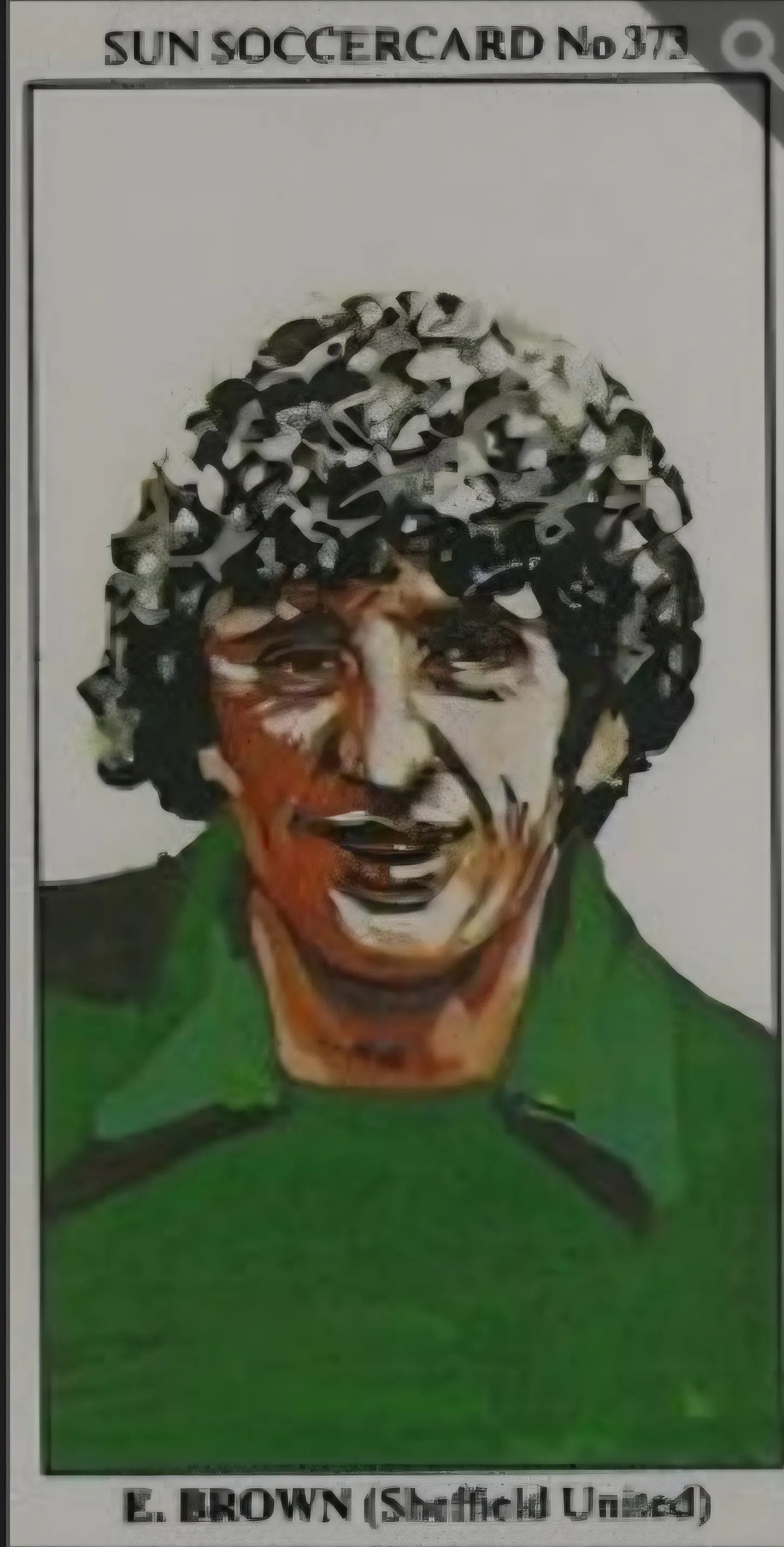
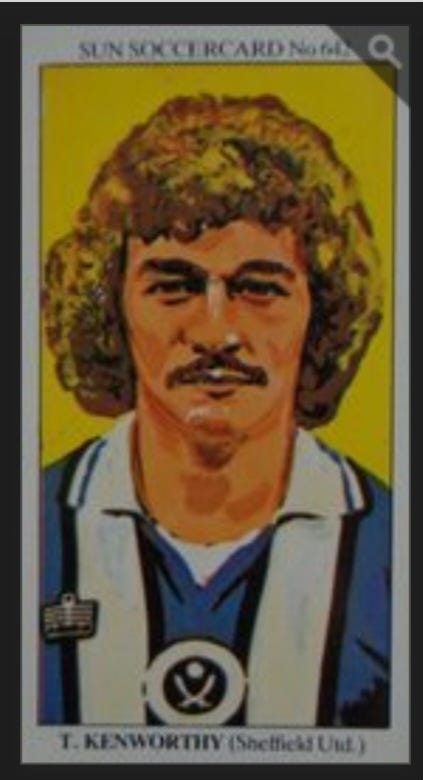
Panini and the Sun were both still prolific in this period, with the paper producing soccer cards. These were artist impressions of players. Sadly, these were not that accurate, not only in their physical likenesses but also in the basic details alongside the drawing. Card number 373 is supposed to show our Scottish international goalkeeper Jim Brown but they misname him Eric and call him a defender! After the early error for Fatty Foulkes, it seems even almost 100 years on, we were not important enough to get simple things correct! It gets worse. Card 642 in 1978-79 is supposed to be Tony Kenworthy. He is wearing a blue and white shirt. Perhaps this was simply a printing error?
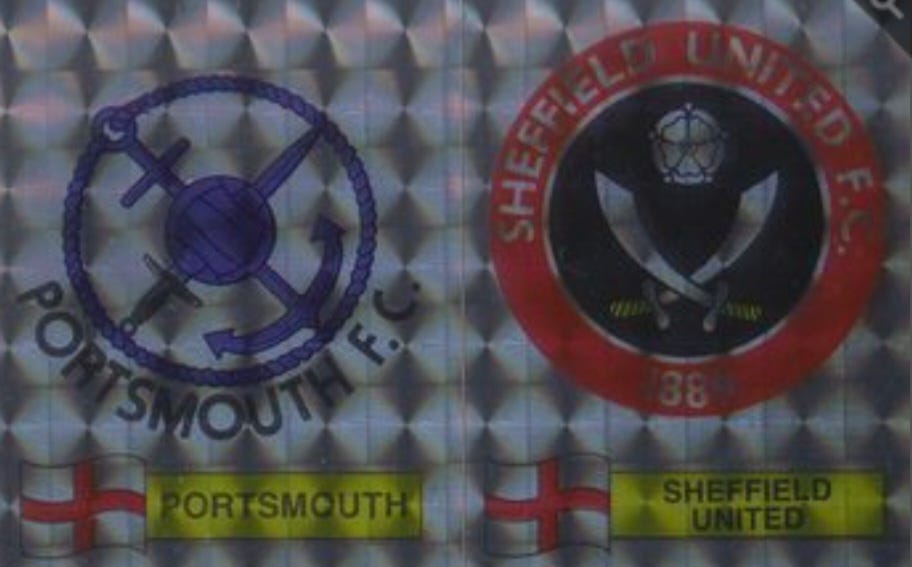
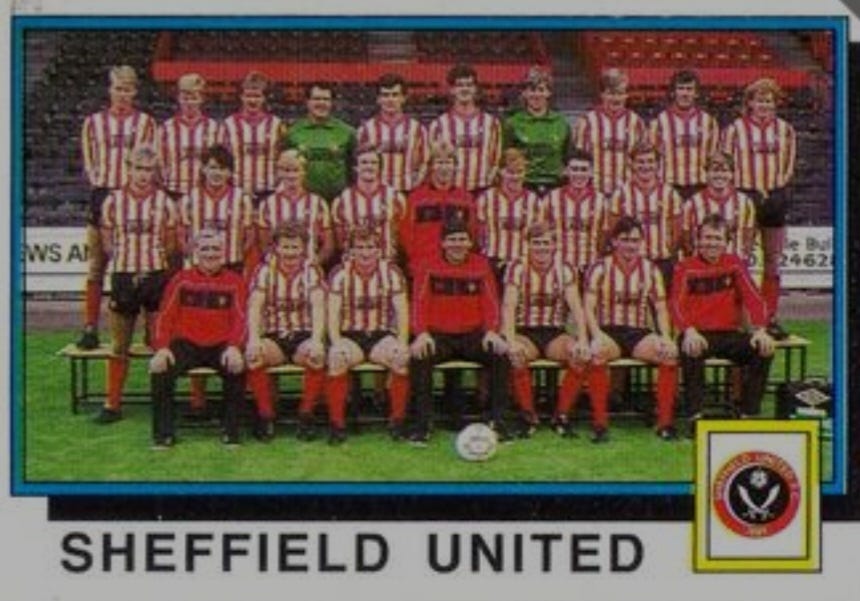
The end of the 70s saw the Blades tumble down the leagues, meaning they were not in the wider football consciousness for a period. Companies were not going to produce cards or stickers for a side plying its trade in Division Three, and then Division Four. For a period of 3 seasons we did not have any card or sticker produced (1981–84). We finally broke out of our slump, and two promotions in quick succession saw us back in the Second Division. Panini did produce club badges and team shots but only the First Division sides had full sets of individual player stickers made. I always recall some of my Wednesday-supporting friends revelling in collecting stickers of the likes of Lee Chapman, Gary Megson and Mel Sterland, whilst my glee came when I got one of the measly two stickers produced for my club. It was even more humbling when the badge was shared with teams such as Shrewsbury Town or Portsmouth, depending which club sat alongside us alphabetically! At least we finally started to get shiny badges – always seen as the most sought-after stickers. ‘Shinies’ or ‘Foilies’ provided a great deal of excitement as the silver sticker glistened as you peeled the sticker wrapper back. To get your own club, even if shared, provided more excitement than it probably should have done to a young Master Deadbat!
Part Three: Mass Productions and Sticker Wars
1986–2026
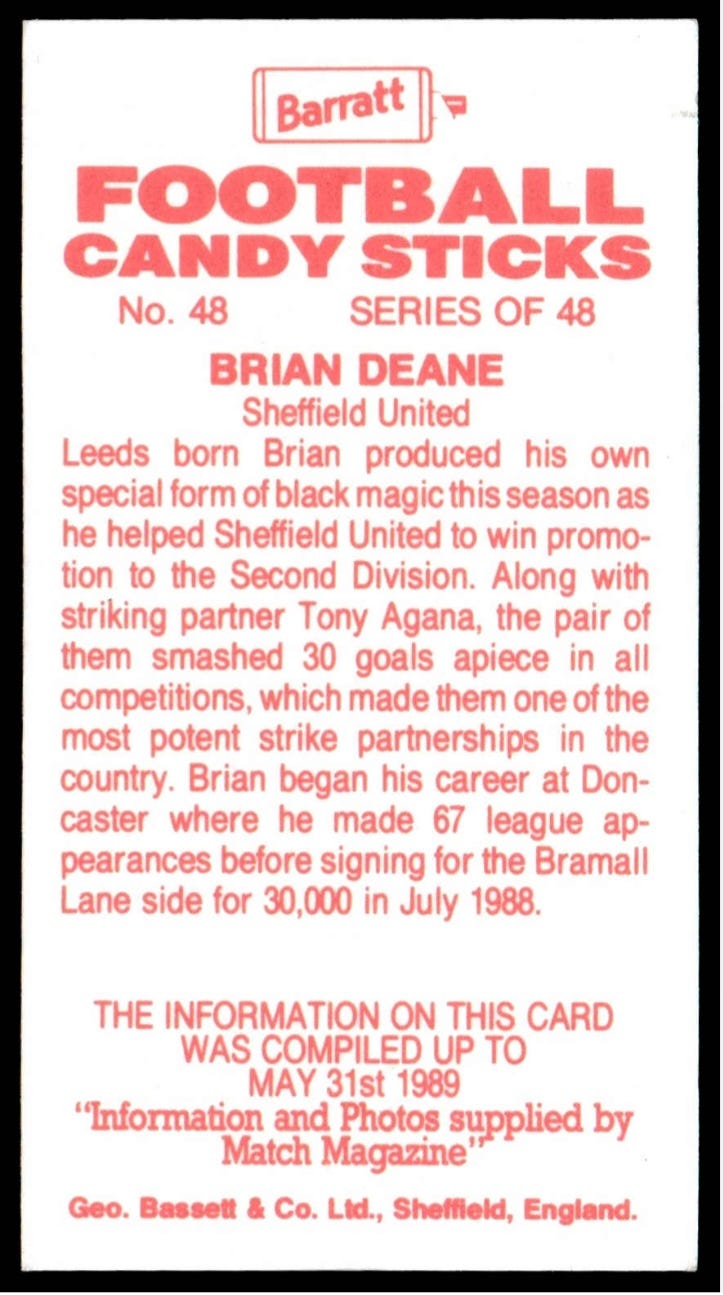
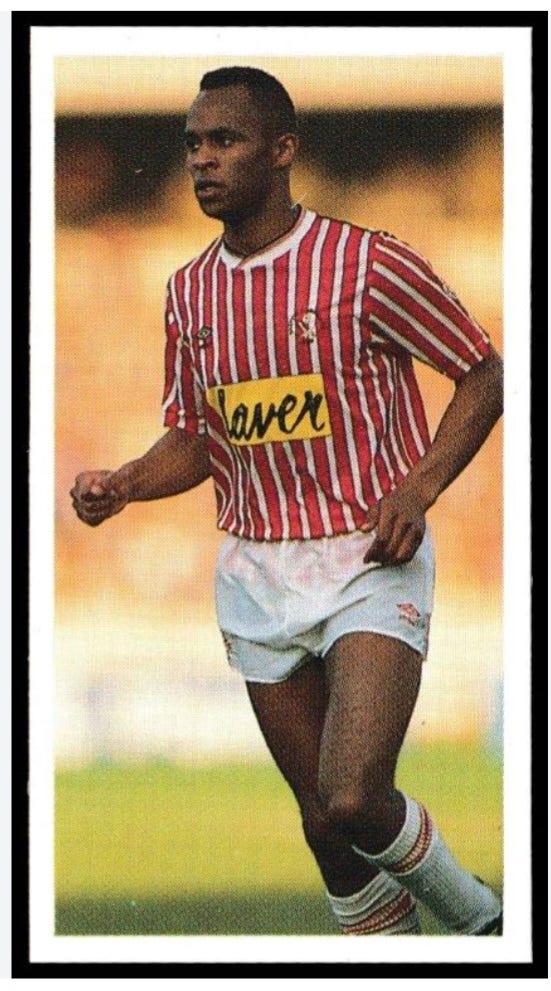
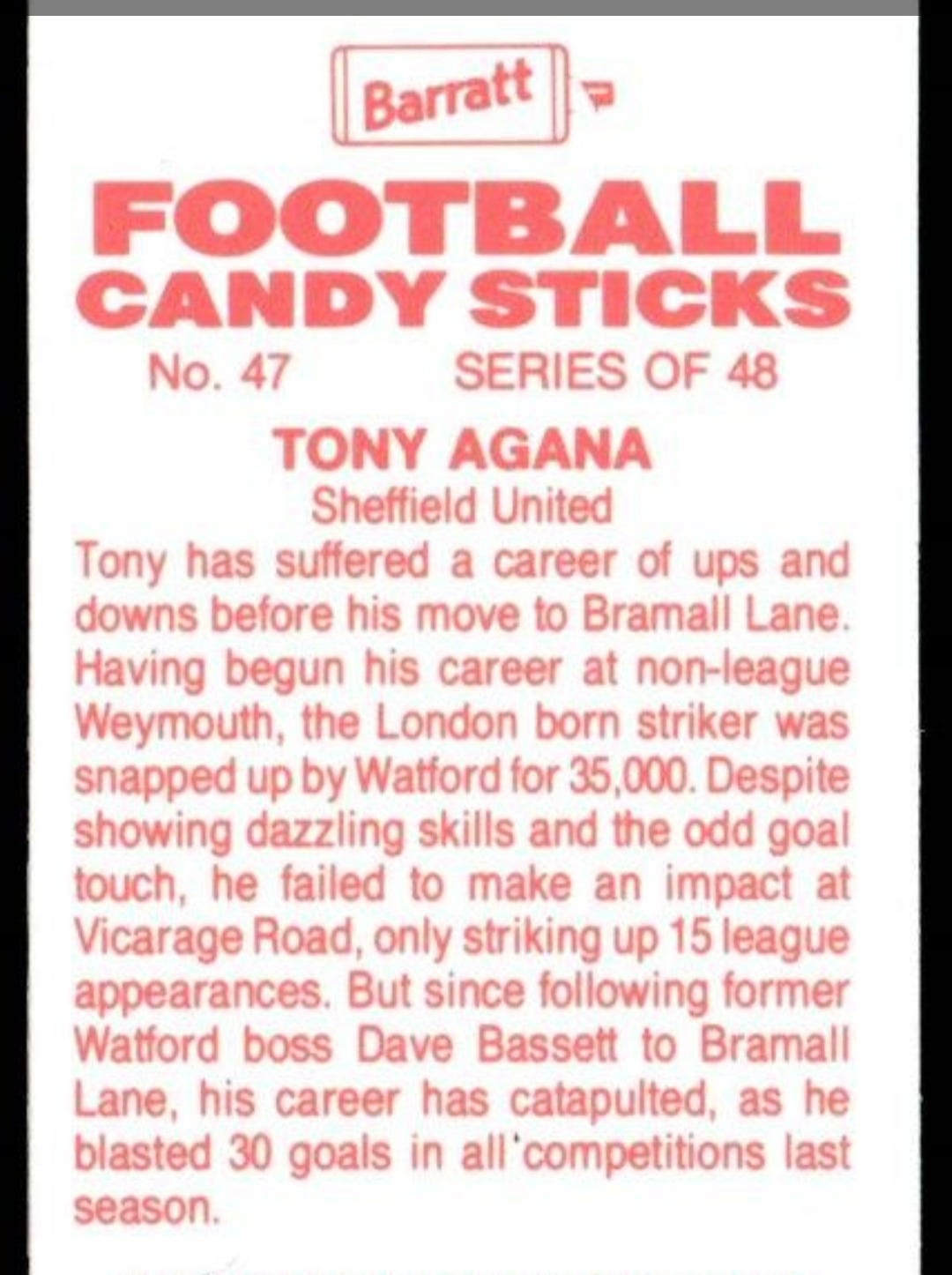
Cards were on the wane but Barratt continued to provide small rectangular cards, tightly packed into their white candy-stick packets, collaborating with Match magazine. Once again, United did not have many of these produced, remaining in the second tier. However, to get Steve Foley, Colin Morris and latterly Tony Agana or Brian Deane, felt like a real coup amongst my schoolmates! The description on the reverse of Deane’s card is extraordinary. It states that he produced his own special form of ‘Black Magic!’ Different times indeed!
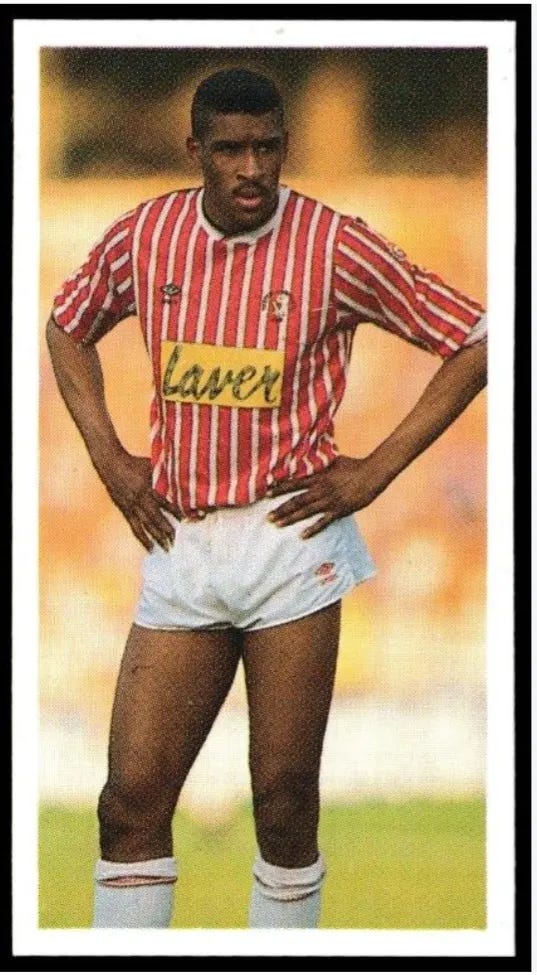
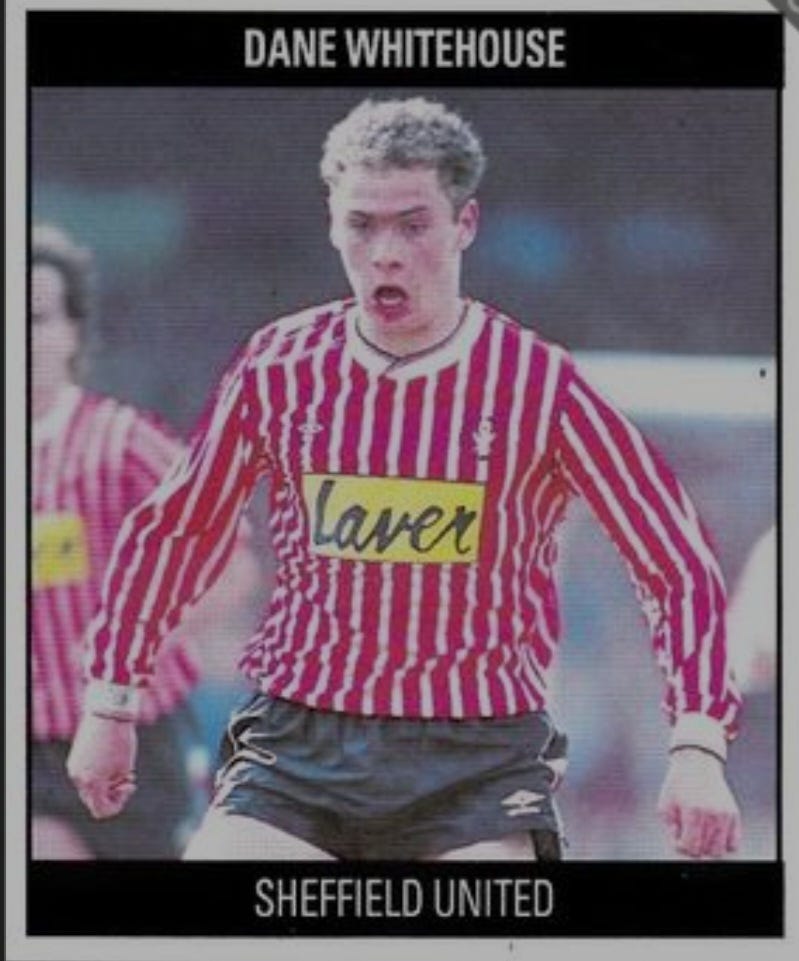
The Orbis Football Collection completely passed me by, which is odd for someone who wanted everything connected to United as I was growing up. These were produced as part of a weekly magazine series in 1990–91. In much the same way as you could collect sets such as the National Geographic or Build Your Own Spitfire, Orbis produced a ring binder/hard folder, that could be filled with stickers. A new collection came out each week that the local newsagent could reserve it for you to collect.
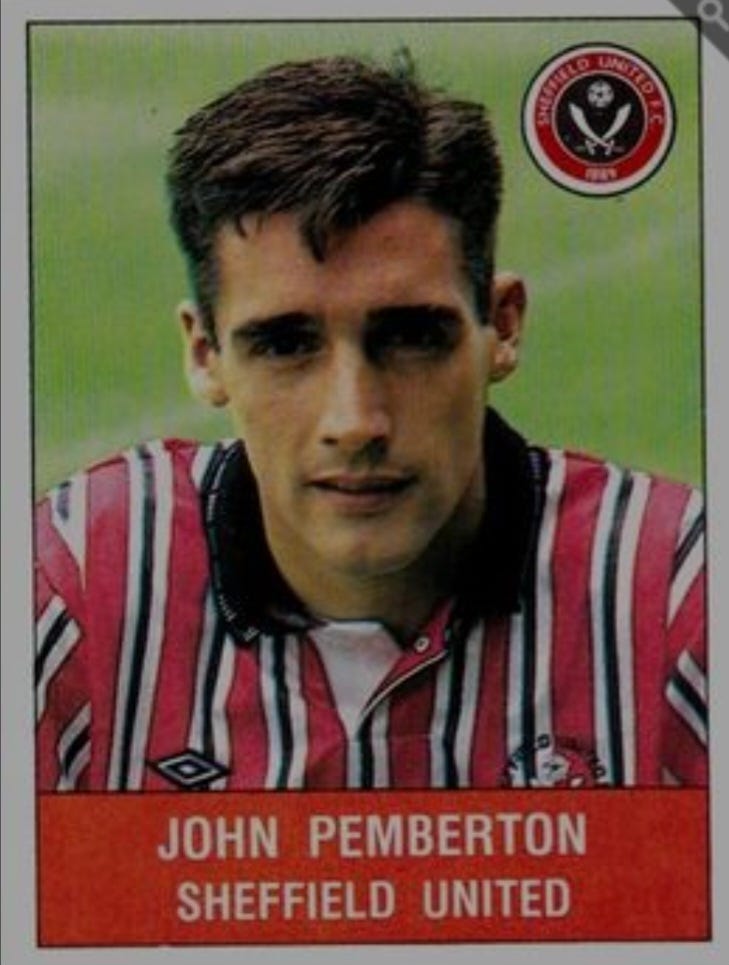
United were back in the big time in 1990–91. One of the most fantastic things about getting promoted was the fact we would have a full two-page spread in the Panini annual album. This would of course continue for as long as we were in the top flight, even if the manufacturer would change during this period. Stickers cost 25p for a pack of 6. I recall once my Mum buying a whole box for me for Christmas which helped me get well on my way to completing it. Sadly, I often still had to send a stamped addressed envelope to Panini UK to get the stickers I needed to complete the collection, as I was sick of getting the same swaps. I must have got Paul Beesley around 17 times!
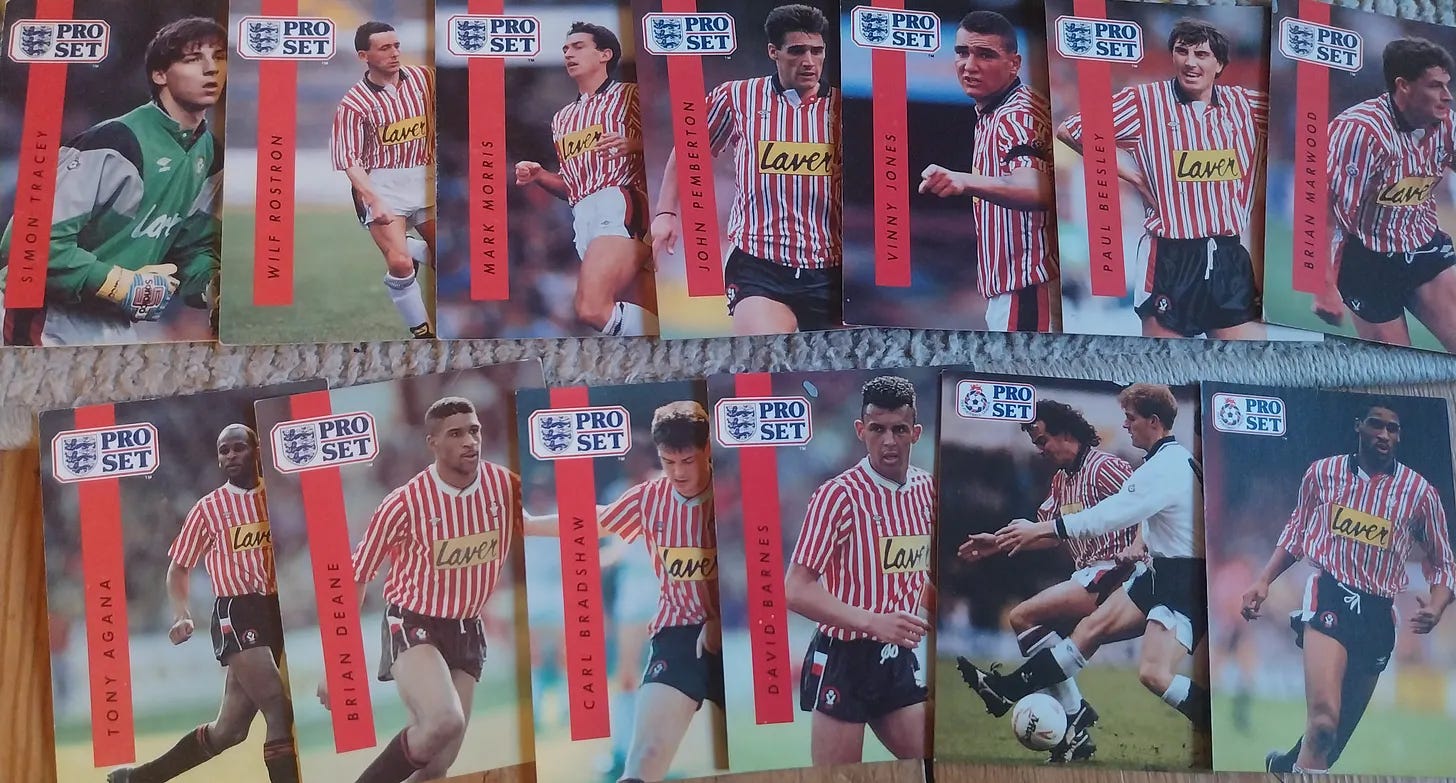
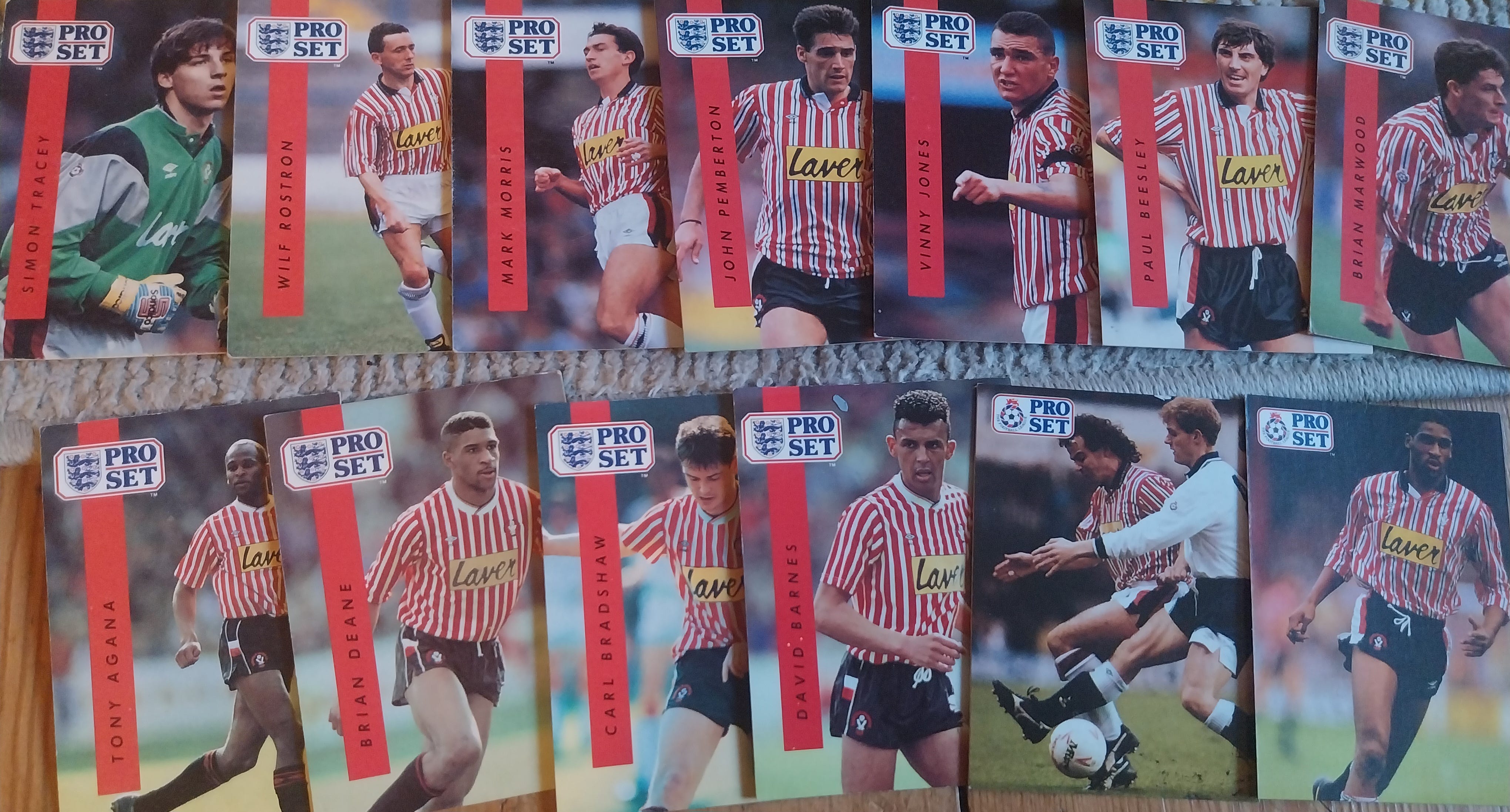
It did seem like stickers ruled the world, with the big World Cup albums always being sought-after collections for me, so it was a surprise I got hooked by another card set that came out in the early 1990s. ProSet were a Dallas-based trading card company that had been successful in the production of NFL cards but had maybe seen the foray that Topps had enjoyed in the 70’s and produced 328 UK football cards. What made this collection unique was that whilst it did focus on the top division clubs and United were given 12 cards, it also featured individual players from some lower league clubs. These cards were high-quality productions with vivid photographs, detailed descriptions and were sturdier than anything produced before. There were additional cards that came out in the 1990–91 season, after Christmas. I proudly managed to complete the full set, although again resorted to sending away for an unknown Sunderland player called Hauser, that had eluded me. I still have these amongst my old United programmes. The second series upped the quality even more and United, again, had a full set of players and a fixtures card.
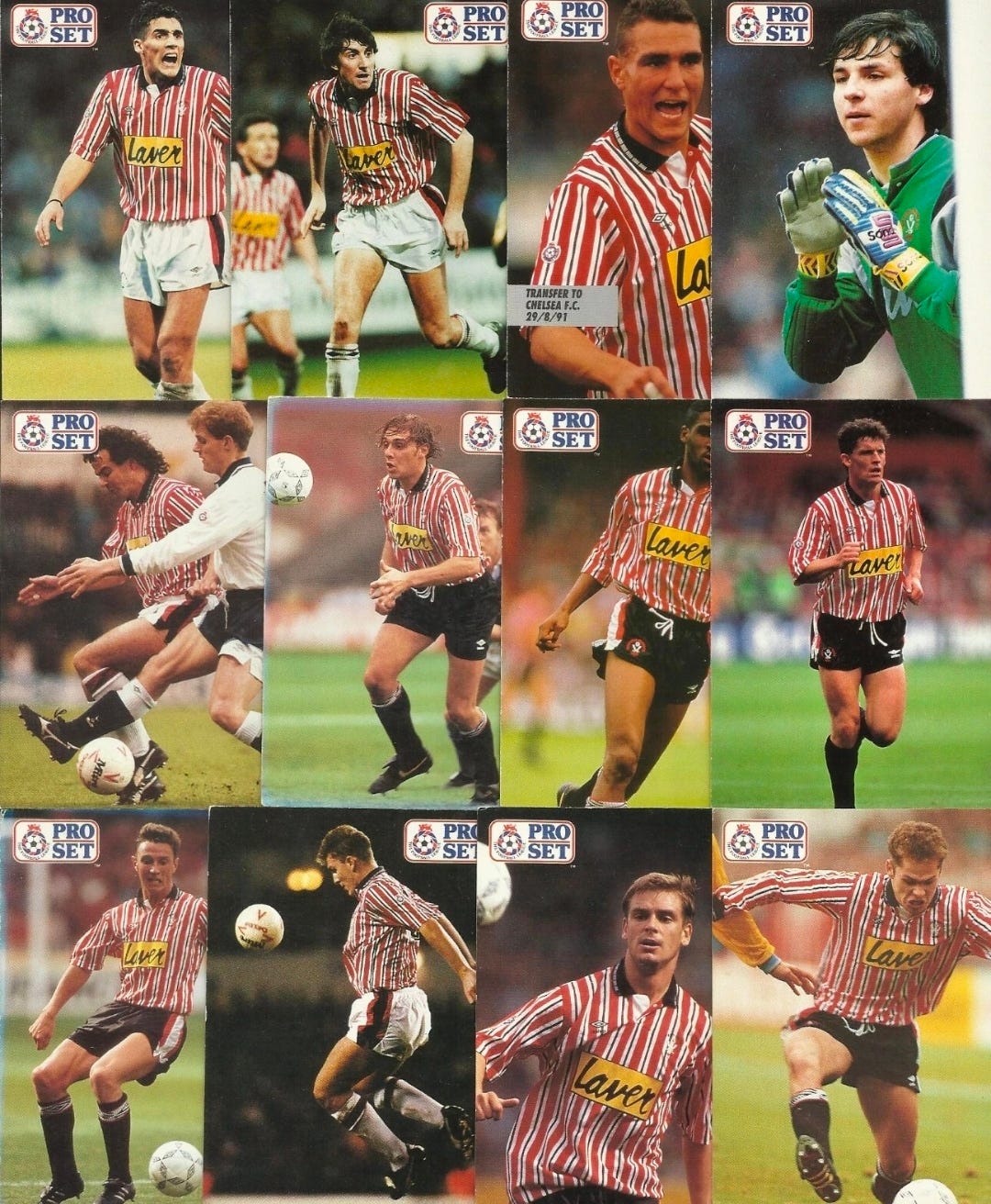
The Sun Soccer Stickers were given out in the newspaper as the game had a renaissance, with bigger crowds and interest, after the success of the national side in Italia ’90. Panini continued to operate but we also had another new name, that of Merlin. This company was set up by former Panini executives after Robert Maxwell acquired Panini. Their Shooting Stars set in 1992–93 had 14 United cards.
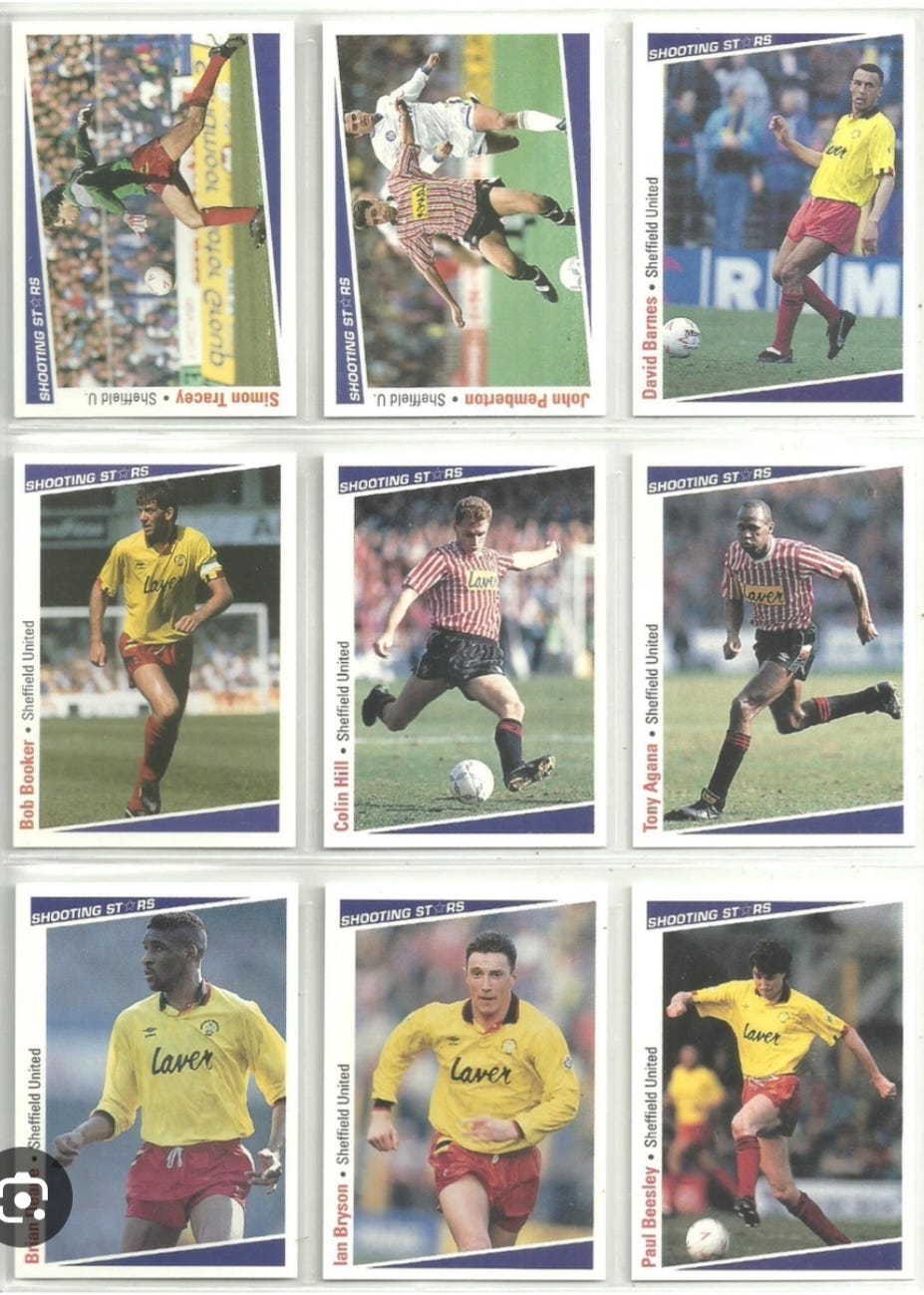
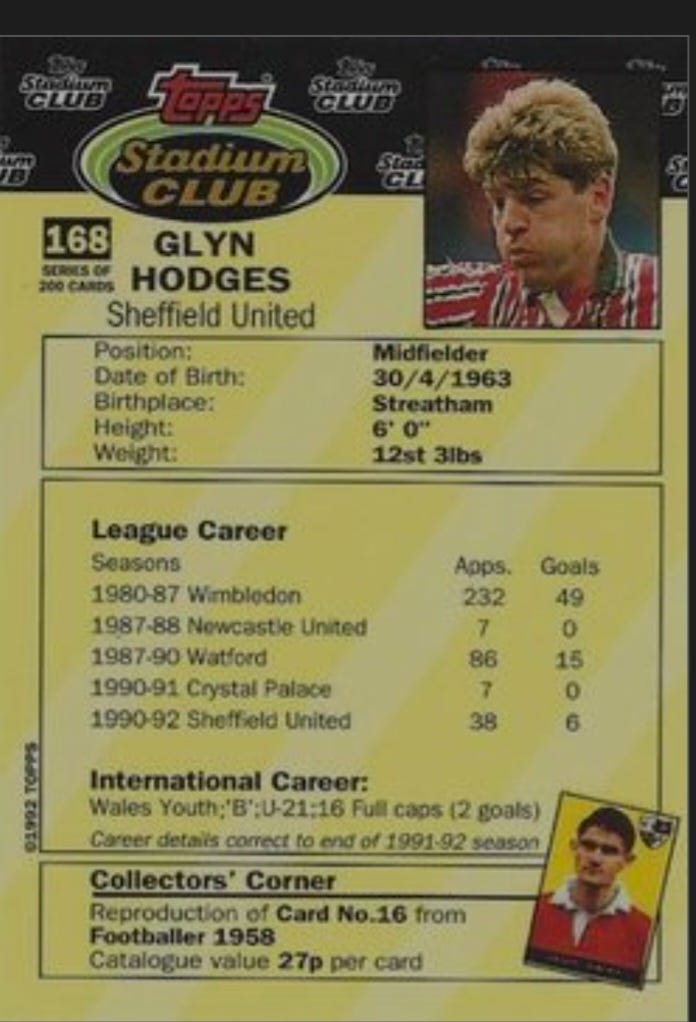
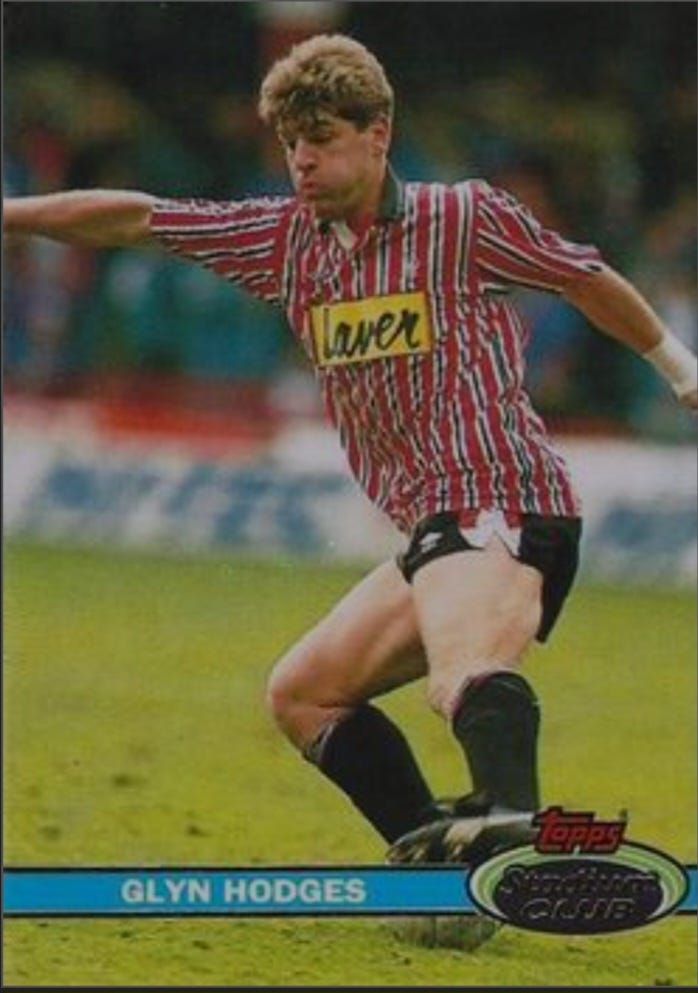
Topps had been away from the game but started to see the game’s growth in the 1990s and we had 6 Stadium Club Cards in 1992. It was a halcyon period with Panini, Merlin, Topps, Barratt’s, ProSet and the Sun operating side by side – and it was becoming an expensive hobby for a 13-year-old boy living on the outskirts of Sheffield.
The birth of the Premier League is often seen as a watershed moment. Sky TV took over much of the coverage of the game from terrestrial television but there were also changes in the sticker/card markets. Merlin were given the rights to produce the stickers for the new league. This dealt a real blow to Panini, who had been the official partner of the Football League for a long time. Bizarrely, even though Merlin produced their first Premier League collection in 1992–93, Panini still produced a collection, even though it was unofficial, called Football 93.
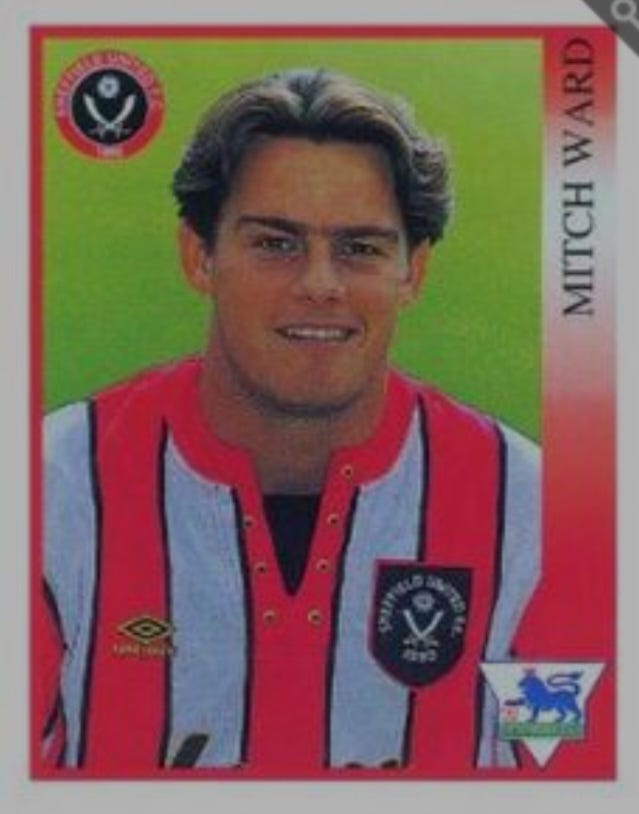
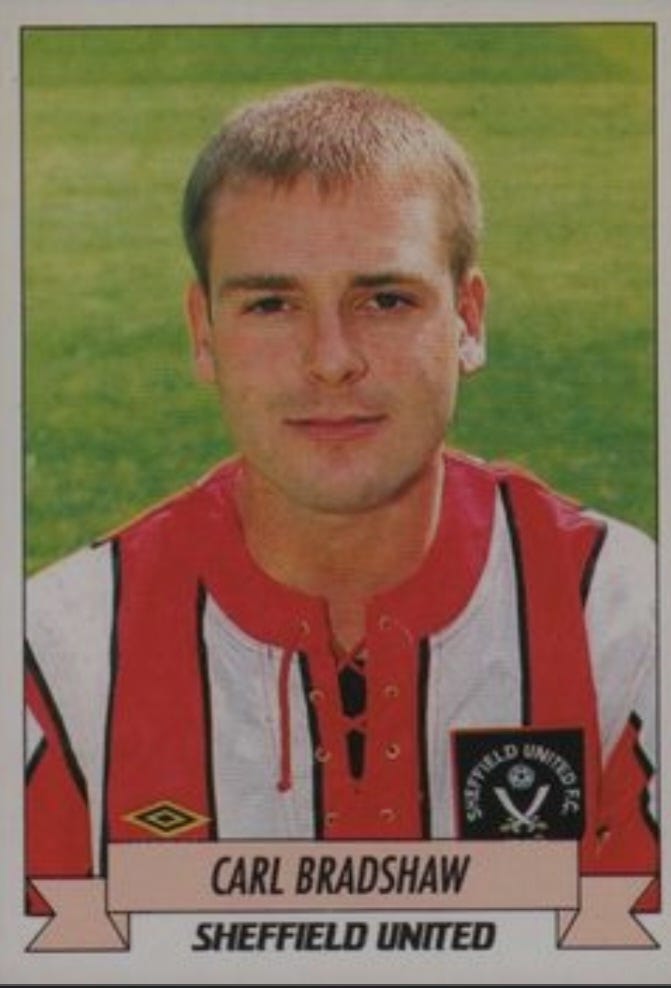
Merlin were bought out by Topps in 1995, but the Blades, of course, had suffered a heartbreaking relegation. The one consolation was that Panini were now producing stickers for teams in the Football League. The Richards Collection brought out cards of old footballers in 1997 seeing players such as Jimmy Dunne and Bob Barclay and JF Sporting Collectibles continued this nostalgia with its own Popular Footballers set, featuring Tommy Hoyland and Graham Shaw, amongst those you could collect.
With the popularity of personal computers and video games, youngsters were much more likely to play on their Sega/Nintendo and then PlayStation/Xbox, with FIFA, Pro Evolution and Championship Manager/Football Manager taking over from the simpler pursuits such as Subbuteo and card/sticker collecting.
The Blades were unable to return to the Premier League for over 10 years but finally, in 2006–07, Neil Warnock managed to achieve promotion. This return saw United once again feature in card and sticker collections. The MagicBox Shoot Out set featured 22 Blades players. The fact that a new name came onto the market showed there was still an appetite for this type of hobby.
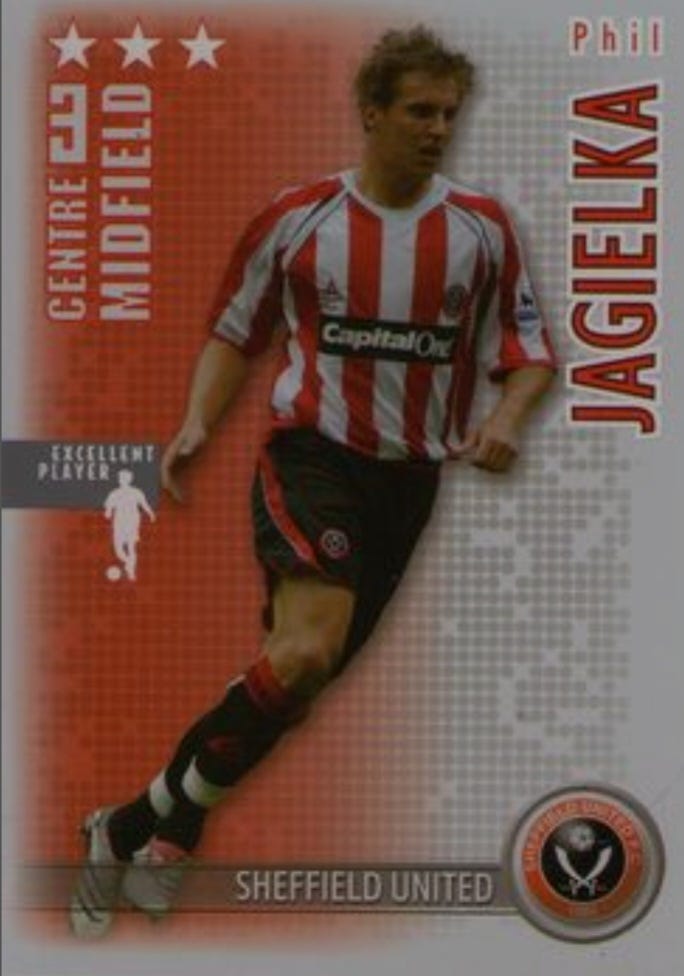
Merlin were still involved in the Premier League sticker collections, and United had 21 player portraits, a club badge, squad, kit and star player for this single season.
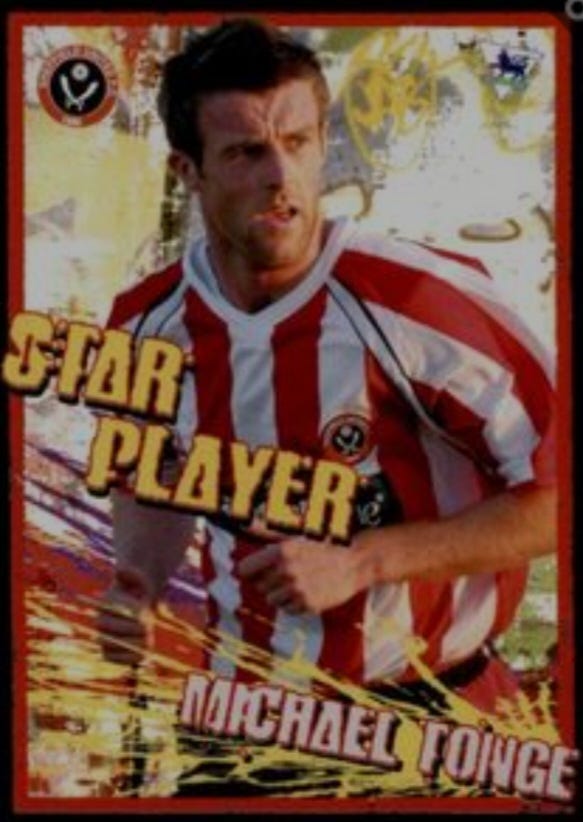
Topps also produced a card set of 13-card set for that brief return to the top flight. Whilst United’s foray back into the big time was brief, they could at least still buy stickers as Panini continued to operate in the Championship. This did not continue and as United had another extended spell out of the limelight, the collections moved to Match Attax, a series from Topps. From collecting unique cards to engaging in strategy-filled matches, Match Attax was marketed as providing endless fun for enthusiasts. There were many types of cards for the top players and teams but the Blades were not among them so, for a long period, had nothing produced at all; —a far cry from the early 1990s.
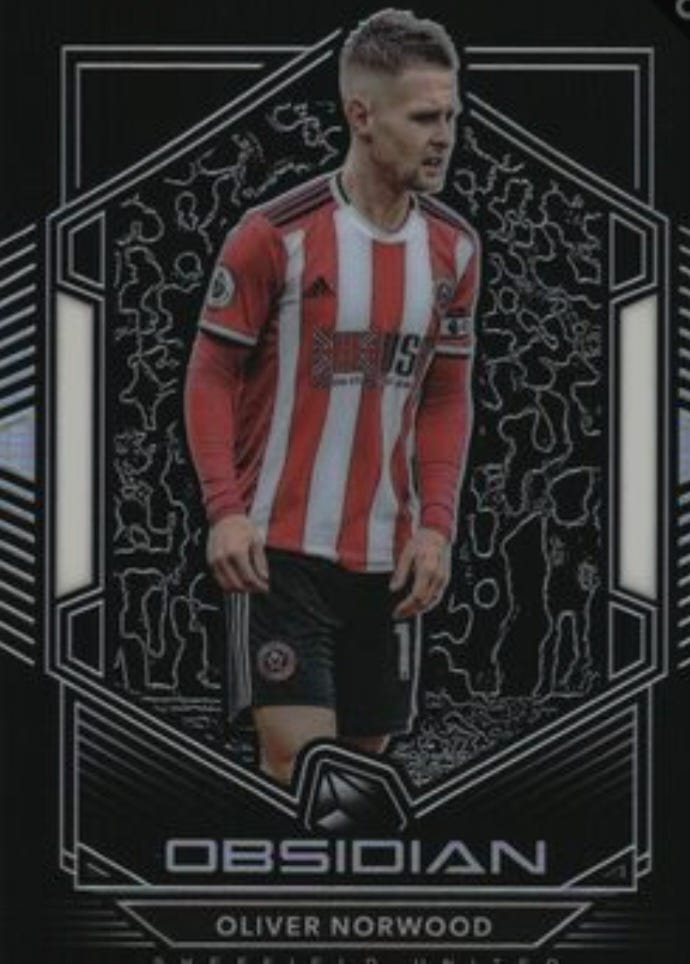
In 2018, Panini was back at the top table and once again the official supplier to the Premier League. United returned the season after and Panini were now prolific in producing cards and stickers in many guises. The Adrenalyn XL, Chronicles, Obsidian, Prizm, Immaculate and Impeccable Series saw a huge number of trading cards featuring the Blades. This was an exhaustive collection – almost too much – but clearly there was a market for it. If you wanted, you could collect eight different Lys Mousset cards – to show the range they offered!
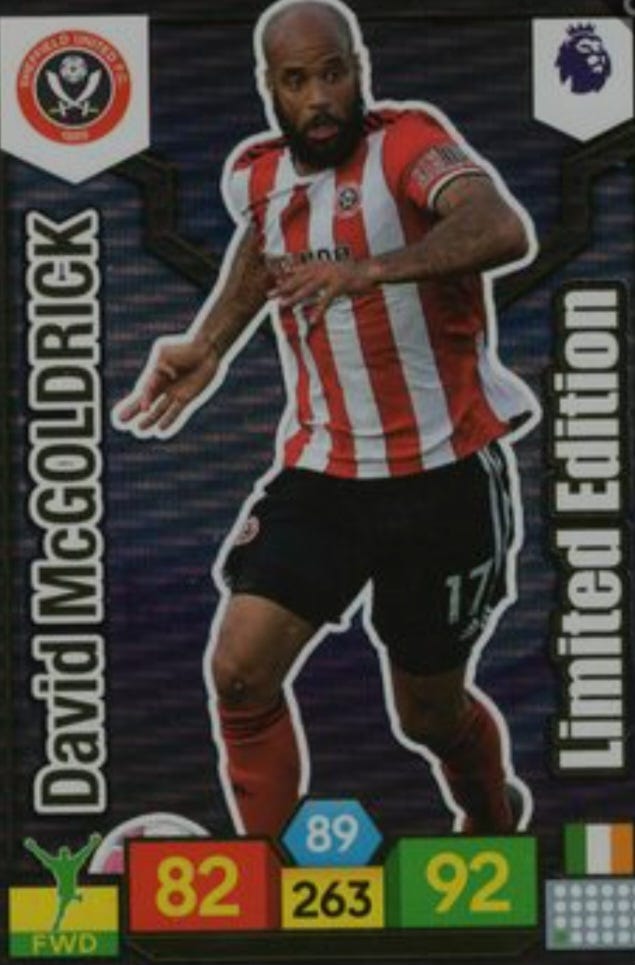
We also had the traditional sticker album brought back – the first time we had seen it for a long time. Having a young son meant I had an ‘excuse’ to ‘collect,’ and we filled the two-page United section fairly quickly although I felt the expense, in the same way my own parents must have. We also had the return of the much-loved, ‘Shiny’ badge, in the renaissance of the sticker-collecting habit.
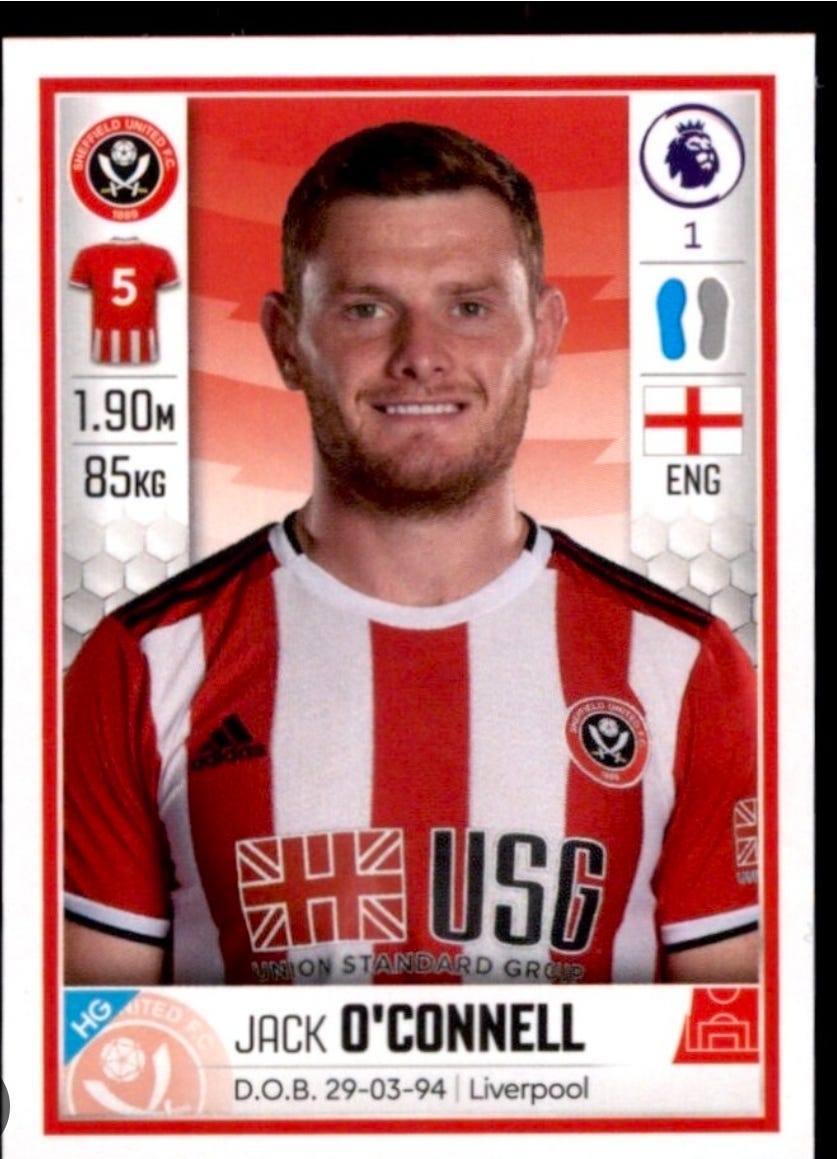
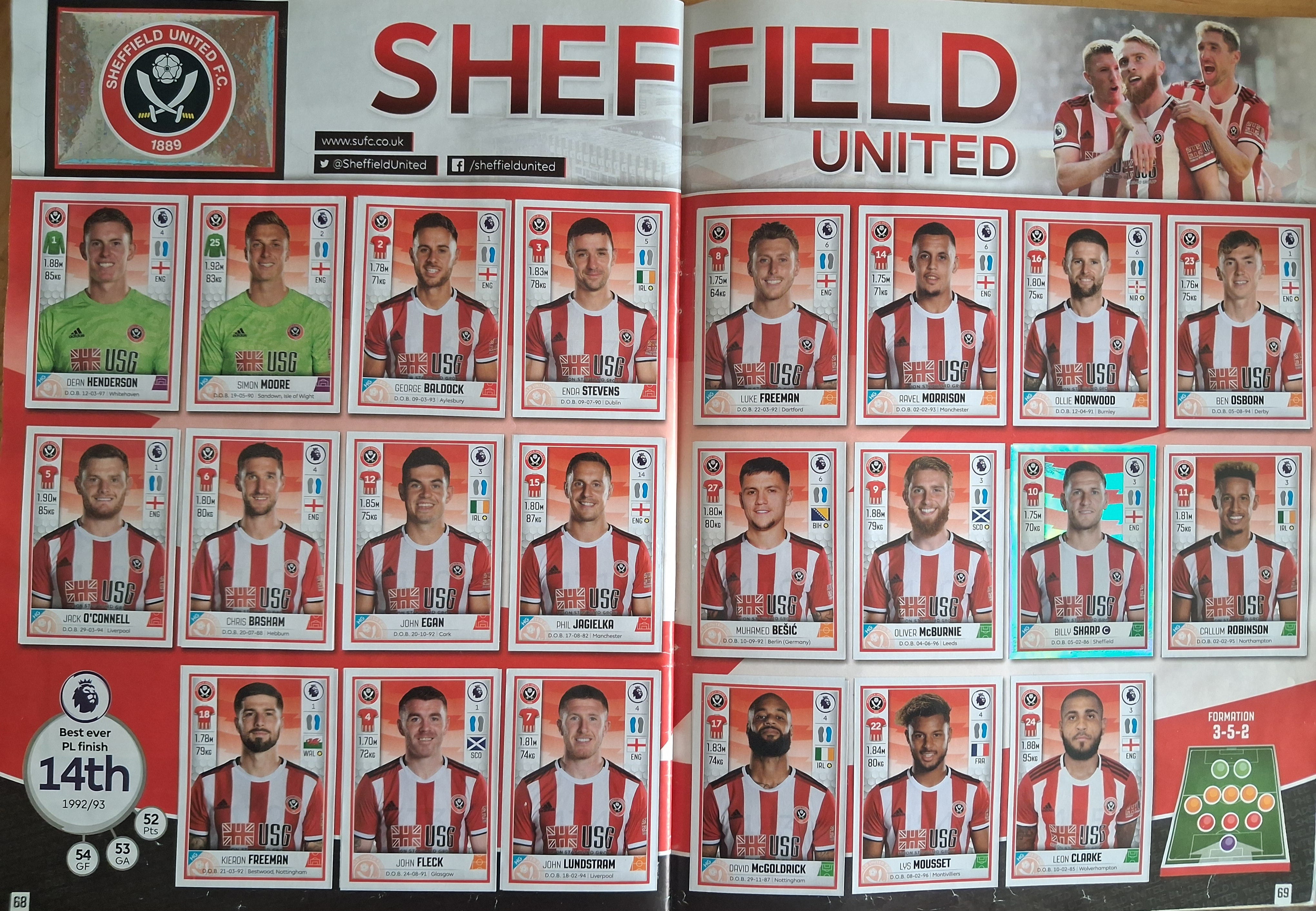
The collections expanded even further in 2020–21, the Blades second season back in the Premier League, but Covid had an impact on everything, including buying habits. However, it seemed the demand still remained, even with people’s shopping habits changing to online purchases. I stopped my own son buying another album, citing the vast cost. Maybe I knew what was going to happen, in terms of our disastrous season behind closed doors?
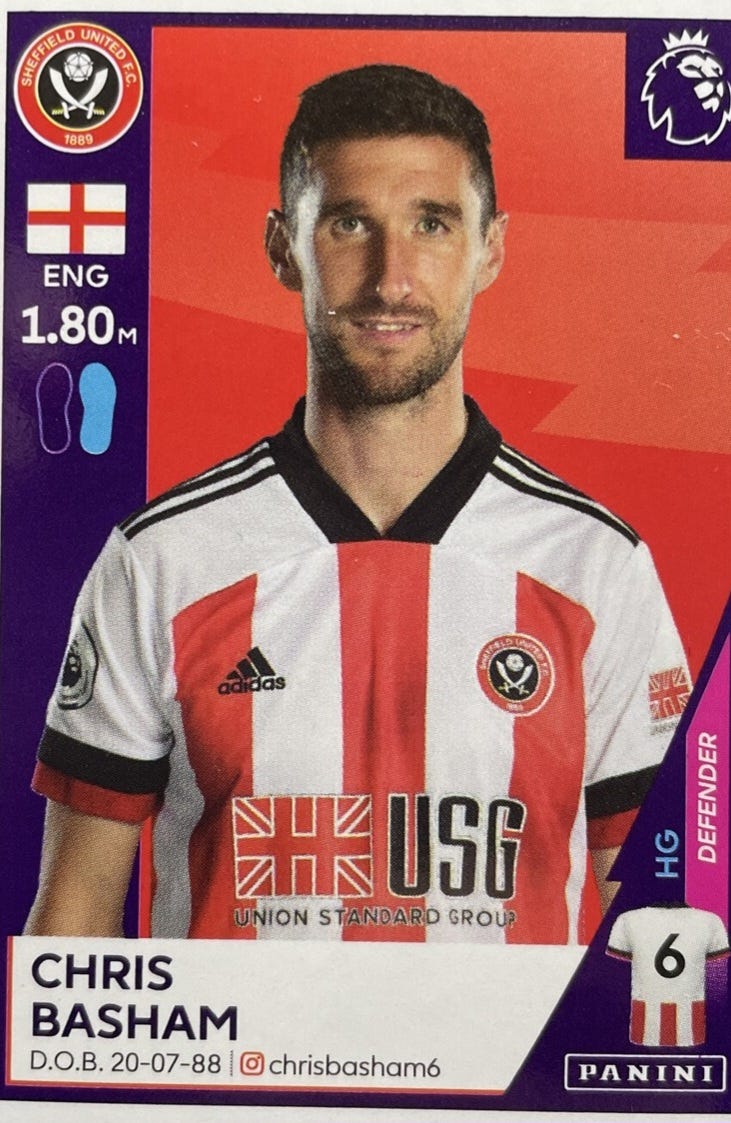
It was only two seasons before United won promotion again and the sizeable number of cards and stickers you could purchase were available again for our club. There were various silver, gold, embossed, and ‘rare’ cards to obtain. We still had the traditional sticker album alongside these but once again I resisted the urge to start collecting as a packet of only five stickers now cost £1! The stickers also seemed to be smaller, a trend we saw with other products like chocolate and crisps.
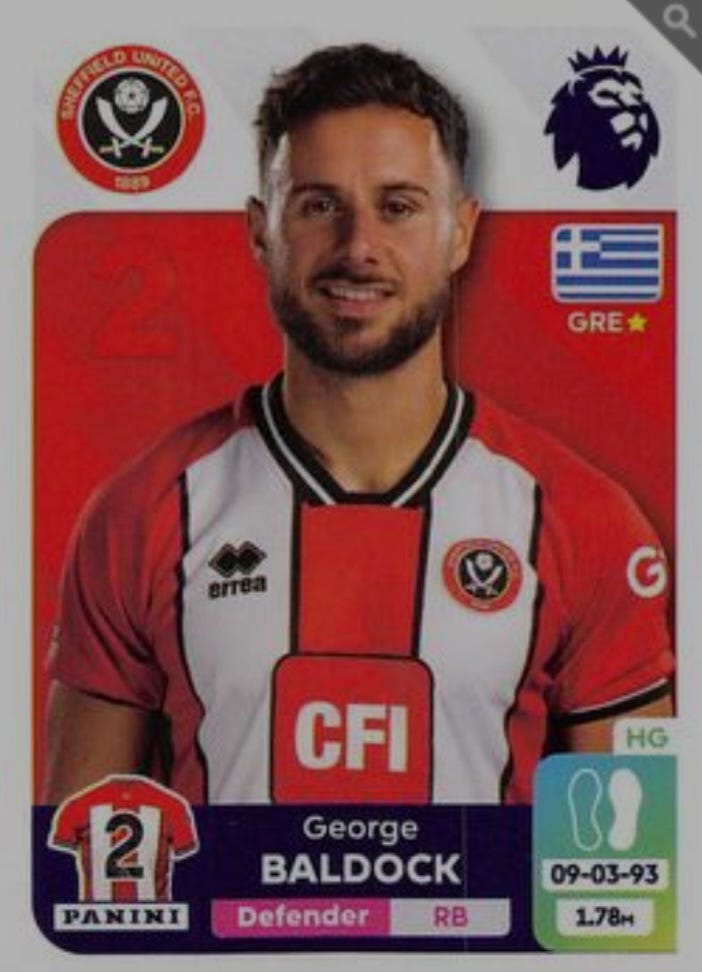
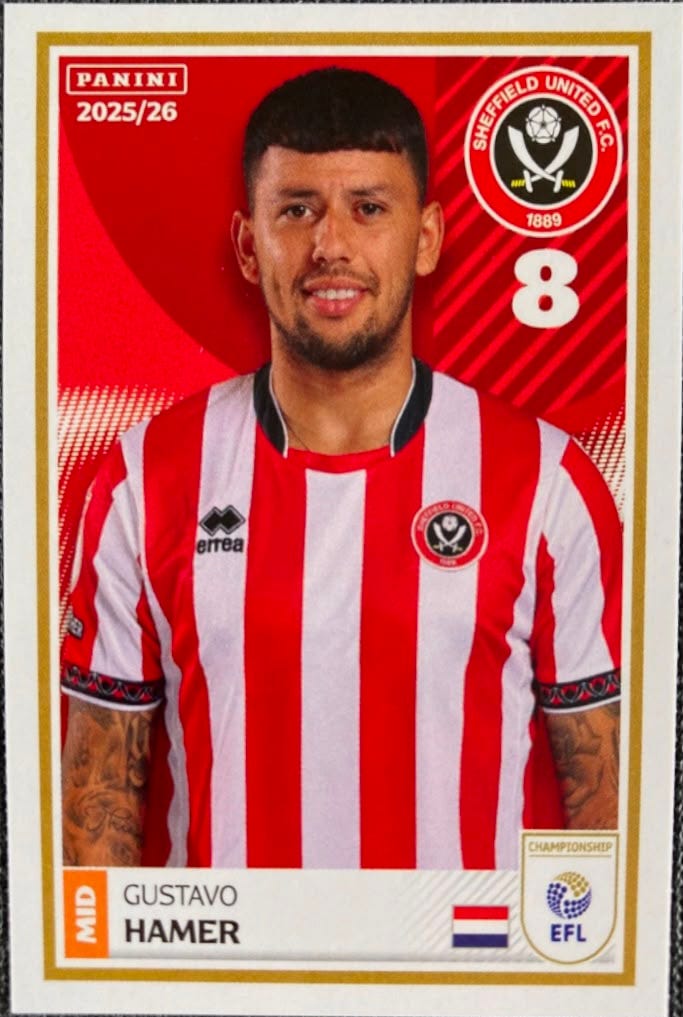
As the Blades yo-yo years continued, so did that of the sticker licensing companies. Topps, now in collaboration with Fanatics, who had bought Topps for $500 million in 2022, took over providing cards/stickers for the Premier League. Panini, though, refused to bow out and, once again, opted to get involved with the Championship, bringing out an album for 2025–26, so the Blades were still ‘in the game.’
The future of this hobby remains to be seen. It is remarkable how it has managed to stand the test of time, through two World Wars, a global pandemic and the introduction of so many newer, alternative pastimes. The fact that people, young and old, still relish the feel of a card/sticker in their hand, attest to its longevity and timeless appeal. In much the same way as books have remained sought after despite the introduction of e-readers, and radio has remained popular alongside television and streaming, it seems probable that, in some form, the football card and sticker will endure for many years to come.
What a brilliant piece this is. Those Sun cards are so bad, they remind me of some equally badly drawn PG TIPS ones of the England squad.
Thanks, David – what a fascinating article.
You very genteelly call them “cigarette cards”; when I was a kid they were known as “fag cards” … different times/different language, as with Brian Deane!!
I wasn’t really into football, although I recall my dad, as a teacher, vying with some of his pupils to find something really collectable; but they were certainly this girl’s collectable encyclopaedia on all sorts of other subjects. What a fantastic trip down memory lane!
The colour painted chromolithographs are really good – better than some modern-day passport photos!
Interesting that Panini came up with the self-adhesive stickers. I can remember having to glue my cards into an old scrapbook (expensive hobby, as you say, so no actual albums). And good to note that cards continued even after stickers were introduced. And why am I not surprised to see that, as teams slipped down the leagues, their players didn’t feature?
Your final paragraph is very true. There is definitely still room, I think, in this modern technological world, for simple pleasures. Well done Panini and others for keeping the tradition going.
Sue.