

Sticking, twisting, gambling with our future.
Sam Parry
That’s how it all feels to me right now. And speaking of gambling…
I’m a member of a Telegram chat covering every club in the EFL. It is a nice place to be—rather like Twitter used to be. Arguments, when they happen, are treated as arguments should be: a back-and-forth of logical reasoning until someone concedes a point or both parties accept that they disagree.
The other day, after the bookmakers updated their relegation markets, somebody in the group said, and I’m paraphrasing: “I’m interested in Sheffield United to go down at 40/1.”
My response was not one of shock.
Forty-to-one implies a relegation probability of around 2.44%. Looking at Sheffield United’s squad as it currently stands (plus off-field questions), I am not convinced the risk is quite that small.
That is not the same as predicting relegation. Chris Wilder is rarely prone to making a team worse than the sum of its parts. I would only seriously consider the bet if I did not rate those parts—and not rating United’s playing staff is a reasonable position for many outside observers to hold. We are not outsiders, though. How do we parse what’s happening right now?
Do we need to rebuild?
This may fly in the face of what most people think, but transfer windows—other than when a club has been relegated or promoted—should not be defined by “rebuilding”.
In fact, I wrote a piece on NTT20.COM about how 66% of teams finishing inside the play-offs (25/26) across the Championship, League One and League Two signed fewer players than the average club. More compelling still, six of the seven automatically promoted teams signed fewer players than the club average of 11 summer signings.
Sheffield United don’t need a rebuild, but I’m worried we’re being forced into one. The off-field stuff is boringly predictable and hugely concerning. The squad is bulky in numbers and light on true quality. The question that lingers about our squad is who can be trusted to play a significant part across a full season. Simply put, we cannot afford to rid ourselves of our most trusted assets. We need a strong core.
Who are they?
Two buckets
I would divide the squad into two broad categories: players we can reasonably trust to provide more than 2,000 competent Championship minutes, and players we cannot.
By “trust”, I mean a combination of availability, likely selection and proven performance—by which I mean being at least capable at Championship level. Those players I “question” might not be down to their quality.
The figures below are league minutes from last season.
Bucket of trust: 2,000+ minutes
Japhet Tanganga — 3,735
Callum O’Hare — 3,458
Sydie Peck — 3,297
Harrison Burrows — 2,960
Femi Seriki — 2,559
Gustavo Hamer — 2,502
Andre Brooks — 2,442Tyler Bindon — 2,029
Aside: I find it slightly odd that we don’t talk about minutes/availability more as the central determinant of how well a team performs. Game time is everything—or, at least, close to it. Talent is secondary if it is rarely available.
Bucket of questions: fewer than 2,000 minutes
Tyrese Campbell — 1,886
Patrick Bamford — 1,823
Mark McGuinness — 1,804
Thomas Cannon — 1,721
Jairo Riedewald — 1,481
Sam McCallum — 1,208
Oliver Arblaster — 893
Tahith Chong — 669
Joe Rothwell — 431
Ryan Oné — 127
Jamie Shackleton — 21
The split is not a definitive judgement on quality. Some of the players in the second bucket proved to be excellent signings or major contributors - see Patrick Bamford. At the same time, the difference between contributing within your minutes and actually playing enough minutes to make a telling contribution is… well, telling.
There are far more questions than answers within this squad. It is bloated, less talented following the departure of Andre Brooks and reliant on several players whose fitness, form or role cannot yet be taken for granted. That’s a worry.
A promotion campaign cannot be built around a handful of near-certainties and optimism. It cannot be built around the injury-prone. Even a mid-table finish, as achieved last year, becomes less likely if we do not solidify our foundations. And a relegation campaign? That’s built on churn and chaos.
What of our squad, then?
Rating the Squad
Here I want to run through the key areas of our squad and take a judgement on:
whether we’re well set with the players in the building;
in need of additions
exposed if players leave
Central defence
Japhet Tanganga had his critics, but his availability was exceptional. He was a centre-back who could be relied upon to start almost every week, and that sort of continuity is vital. Happy there.
Mark McGuinness appears capable of being a solid third-choice option, but lacks the pace and on-ball quality to be the foundation of a strong Championship defence. Jamal Baptiste has had some minutes in pre-season and did well on loan for Rotherham, albeit in a relegation season.
Until we do some business, then, United will begin the season without a strong central defensive partnership. For a team with ambitions towards the top end of the division, that is not sustainable - or else the ambitions aren’t.
Full-backs
Femi Seriki played a substantial number of minutes last season and was one of United’s better and more exciting performers.
Sam McCallum’s injury was not a recurrence of a previous problem, so there is some reason to trust his availability. We can certainly trust Harrison Burrows, who recovered from a difficult start to contribute either a goal or an assist roughly once every four games.
For now, I am not overly worried about this area.
That would change quickly if either Burrows or Seriki (or both) were sold. Both provide attacking threat, energy and progression from wide areas. Losing one—or both—would not simply reduce the squad’s depth; it would remove a major source of creativity.
Wilder has also spoken about Jamie Shackleton having a role this season. Shackleton has played only 981 league minutes across the past three campaigns. I have sympathy for his injury problems, but I have not seen enough underlying quality to justify relying on him for a meaningful role. Tom Davies, for comparison, was also an injury risk, but there were moments when his talent made the gamble understandable. I do not currently feel the same way about Shackleton.
A brief pause to ask you a question…
Do you value what we do? Do you think it matters that every writer who contributes to The Pinch is paid? We want to keep publishing articles and recording podcasts, but we can only do that with the support of our readers. A subscription costs £40 per year or £5 per month. If you enjoy our work and would like us to keep making it, please consider supporting The Pinch.
Central midfield
Oliver Arblaster could make good on his pre-injury promise, while Joe Rothwell, with proven fitness, might become a genuine asset.
There is also the curious case of Jairo Riedewald. United scored more frequently with him on the pitch than with any other player and conceded less frequently too. Those numbers require context—he came off after the hour in every game—but they make the decision to release him and re-sign him permanently look a little odd.
Sydie Peck has already become a hugely important player and is rightly attracting interest from higher up the pyramid. If he stays, his minutes/performance level can be trusted.
All rosy then?
No, the wider shape of the midfield is more concerning.
It is a technical, low-energy collection of shuttlers and passers. The problem is not necessarily a lack of decent players. It is that too many of them offer similar things.
United need greater height, more speed and somebody capable of covering ground aggressively without the ball. Ideally, some goals too: remember goal threat from midfield?
There are also, quite simply, two midfielders too many on the books, given that we still have to add in this area.
Wingers and attacking midfielders
Callum O’Hare and Gustavo Hamer can both be trusted to play significant minutes, assuming they remain at the club.
That final qualification matters.
The pursuit of Lewis Dobbin appeared to suggest that one of O’Hare or Hamer might leave to accommodate another attacking addition. United’s interest raised an obvious question: what exactly is the plan for the players already here?
I cannot believe Wilder will entertain another full season of Hamer playing off the left. United struggled defensively with him there, while simultaneously not limiting one of the three most creative attacking players in the Championship. Gus was, to quote Olivander from Harry Potter, “terrible but great” — I’m always pro-Gus, all of the time (just ideally not on the left).
If Hamer stays, his most logical role is as a number 10. If O’Hare stays, his most logical role is also as a 10. That is a question we will see answered soon.
Romelle Donovan at least provides another body following Brooks’ departure, although he is a loan player rather than an asset United own. He should become a useful member of the squad, but asking a 19-year-old to immediately become the side’s principal wide threat would be a strange gamble.
Wilder’s comments about Seriki last season are also relevant. He said: “Femi isn’t going to take you to the top of the division. Femi isn’t going to play 46 games for you in the Championship.”
Whatever the context, Wilder has not always demonstrated deep trust in young players. It would therefore be surprising if United entered the season expecting Donovan or Ryan Oné to carry a major attacking burden without another addition.
Oné’s position is itself uncertain. Is he viewed as a winger, a forward or an out-and-out striker?
My suspicion is that he will begin the season as the reserve left-winger, with opportunities from the bench to prove himself. Personally, I think that would be the wrong call. I would prefer to see him developed centrally, competing with one of Tyrese Campbell or Thomas Cannon to support Patrick Bamford.
Strikers
Strangely, this position may be United’s strongest.
There is no doubt that Bamford, Campbell and Cannon are talented Championship forwards whom other clubs in the division would love to have—never mind all three. Oné may well belong in that group too, given how he performed in League One last season.
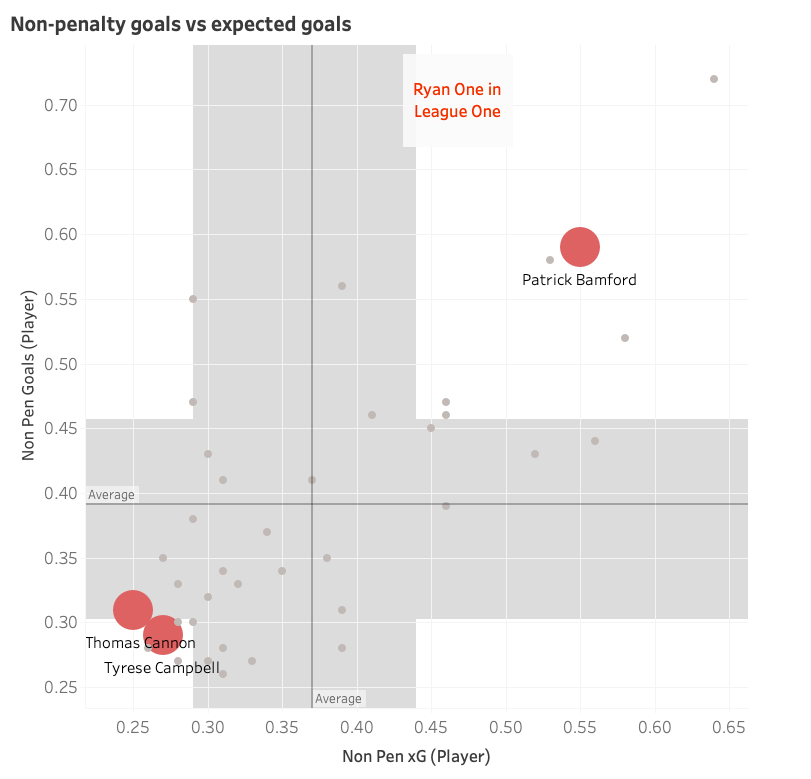
All four outperformed their expected goals last season and can be trusted in terms of their finishing, if not necessarily their all-round contribution to games.
The problem here is not really one of trust, but of getting the best out of three or four players vying for a single position.
Can Bamford stay fit enough to lead the line consistently? Probably. Can Campbell rediscover the explosiveness of the previous season after last year’s intermittent contributions? If he can, we have one of the best in the division and would realistically only need 15 to 20 games out of him. He will probably always carry niggles and is one of the few members of the squad—owing to his position—where we can tolerate his lack of availability.
Can Cannon, our new number nine, establish himself as a regular starter rather than a useful option? I’m sceptical.
And do the three senior forwards complement one another well enough to justify carrying them all?
The ceiling is high. Bamford remains an intelligent and technically gifted striker. Campbell can stretch defences or remain peripheral, but so long as he gets chances, he usually performs well against his expected-goals numbers. Cannon has previously shown that he can score regularly at this level. Oné has the raw skill set to explode.
But none can currently be treated as a certainty for 35 or 40 starts—not necessarily because of fitness, but because there are three or four of them vying for one spot.
Is there a chance we play two strikers in a 4-2-2-2? I think there might be, and that would solve the Hamer and O’Hare question too.
Aside: The Blades did well in a 4-2-2-2 last season, and it might be the formation that fits most naturally with this team. If we go down that route, expect GOALS—in both nets.
So, is 40/1 value?
As the squad stands, I do not believe Sheffield United are likely to be relegated. Neither do the bookmakers at 40/1. Perhaps they are not factoring in off-field issues, though.
Do I think 40/1 is a little too big and therefore represents good value? Possibly (see off-field stuff). Otherwise, it comes down to squad building, and squad building remains an unanswered question.
In the case of Andre Brooks, Sheffield United have swapped something proven for something unproven. No matter how you rate his quality, he proved himself capable in this league over a substantial number of minutes.
Further transfers like this are a scary thought. It would be a huge gamble to swap the trusted for the untrusted, the tested for the untested, the known for the unknown.
If we were to lose another one, two or three of the trusted players—Japhet Tanganga, Callum O’Hare, Sydie Peck, Harrison Burrows, Femi Seriki or Gustavo Hamer—my concerns would begin to balloon. 40/1 would start looking good value indeed, no matter who the replacements are, because stability is the handmaiden of success, not churn, not rebuilds.
As it stands, I’m more confident than not that this team will make the top eight and therefore secure a play-off place. That faith could be shaken rather quickly.
How much faith do you place in this squad? How much faith do you place in this board? How much faith do you place in the transfer window? How far can we trust a team and manager that only finished 13th? Answers on a postcard.
Trust indeed?!!
Manager- I do still
Owners- not in the slightest
Squad- Can’t answer until the window closes.
But there’s a 4th trust question, the new backroom team, do/can we trust them to gel into a well oiled team behind the team? Especially given that we still don’t know if the manager was forced or wanted the changes!
Fascinating article Sam and I have sent it to the Blades Babes who I sit next to👍